The selected writings below are from SKKAA members and other sources, taken from articles and emails:
 
◊   Summer Camp, by Amy Hull, Wyoming Karate Club
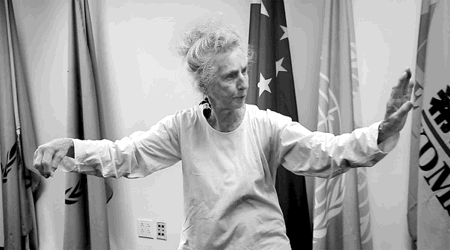
◊   A Soft Breeze of Taiji, by Sharon Skapura, Okinawan Karate Center
◊   Reflections On Forty Years In The Martial Arts: Part One, by Tom Wirtanen
◊   Cowboy Heroes, by Christopher M. Clarke
◊   Pinciples Of Combat, by Sensei Mike Pepe
◊   Steppe Lively: Mongolia's Naadam Games, by Michael Shapiro
◊   Iaido Matrix, by Sensei Mike Pepe
◊   Mu To Yu, by Sensei Mike Pepe
◊   Back to Basics - Forward Into the 21st Century, by Ed Thulin and Jaron Shook
◊   To The Land Of The Rising Sun, by Molly Kempton, Okinawan Karate Center
◊   Saifa - More Than Just A Kata, by Frankie Cardillo, Shorin-ryu Karate Academy
◊   Rolling With Royce, by Jim McDonald, Gokyu, Sessa Kai
◊   Jackson Japanese Fire Festival, by Sue Theise, Yodan, WKC
◊   Translatable Skills, by Faith Van Horne, Sankyu, Seishin Karate Club
◊   In The Ring, by Andrew Mohler
◊   On The Mat, by Shihan James A. True, Jr.
◊   Japanese culture in comics-- not just for kids, by Faith Van Horne, Sankyu, Seishin Karate Club, Columbus, Ohio
◊   Dancing with the Stars, by Rick Ellis, Nidan, Seishin Karate Club, Columbus, Ohio
◊   Waltham Soldier Awarded Bronze Star, Waltham Daily Tribune
◊   Meeting a Master, Butokukai Seminar with Shihan Fumio Demura, by Shihan James A. True, Jr.
◊   En Garde!, by Joseph Daddario, Okinawan Karate Center
◊   Equine Shorin-ryu, by Dee Dee Sorsby, Wyoming Karate Club
◊   Farewell To An Old Friend, by Christopher M. Clarke, Ph.D, Ku Dan
◊   Papa Joe, by Lynda St. James, Sandan
◊   An Overview Of My Kendo Experience, by Susan Hollobaugh, Shodan
◊   Kendo - Then And Now, by Alan Knepper, Yodan
◊   Intensity, by Amanda Lowe, Shodan
◊   Balance, by Mitch Lewis, Shodan
◊   The Eye Of The Martial Artist, by Meghan Boyle
◊   The Ancient Fire, by Meghan Boyle
◊   Where To Take Karate, by Christopher M. Clarke, Ph.D, Ku Dan
◊   As I Remember It - 16 to 60, by Dee Dee Sorsby, Ikkyu
◊   A Striking Experience, by Jeanne MacDonald, Sandan
◊   Do: The Way, by Amanda Lowe, Ikkyu


The following selection of writings are excerpts from the various books available on the SKKAA Publications page.
(For full book descriptions and purchase information please visit the SKKAA Publications page.)
 
◊   Climbing the Mountain - In Search of the Soul of Karate
◊   Kamikaze! The Divine Wind and the Spirit of the Martial Arts
◊   Samurai, Scoundrels and Saints: Stories From The Martial Arts
◊   Warriors and Wisemen: More Stories From The Martial Art
◊   Monks, Madmen and Martial Masters
◊   Little Dragons and Tigers
◊   Honorary Samurai
◊   I Remember When
◊   I Remember II
◊   Fledgling Sparrows
◊   Chasing Dragonflies


       At summer budo camp, bunkai was the big idea. The three days at camp were filled with endless fruitful learning. The first day was about kata outside. We went and did all of our kata on the hill behind the resort. Most of us were bare foot, and doing kata up, down, and sideways on the ski slope was interesting. Stepping on rocks, punching under trees, and kicking up hill put an edge on being aware of your surroundings. This also made us aware of how we did our kata.

       The second part of day was started with the "agony of the feet". This section focused on the lower body, and where the feet and legs can be kicked to create pain. There are seams that you can kick with the heel or the toes for pain. We practiced these in pairs with socks on to protect each other. I am sure most of us were glad our partner brought their pair. We then moved on to various bunkai for kata. Papa Chris made sure we all knew that no move is wasted; a step could be a kick, or a stomp.


       The second day was started with "startle moves". These moves were for when you are first attacked and you're startled. We moved on to more bunkai for kata. This consisted of chokes and grabs to punches and kicks. We added some throws and some pain-giving holds. The last class of the day after supper, we were split into three groups and did rotations to do different things. About half way through class, Papa Chris pulled all the kids aside and let us watch the new karate kid movie. Thank you!

       Through out the days of work out, certain pairs were given the privilege to carry the spirit award for the workout for working well together and working to get the most out of the class. I was one of these. It was me, a green belt, and my partner, a blue belt. We got the spirit award on the second day after lunch. On the last day, each of the pairs came up and did something from the class for which they won the award to recap for everyone. We did two of the take downs and bunkai for kicks. After the pairs, we were all able to see Papa Chris and Sensei Jim demonstrate a few original moves from the old kata when a commoner might be attacked by a samurai. They were empty-handed defenses against various sword attacks. We then all did our kata and I am sure we all saw the difference in our kata because of the thinking about and practicing of bunkai . Overall camp was filled with some pain, humor, and lessons. As a first time goer, I am glad I went. I loved how we ate, slept, and talked karate for the weekend.


Top of Page


       How many of you plant a garden every year? What do your plants need to survive? They need sun, water, food, soil, and space to grow. Do you talk to your houseplants or play music? Do fertilize your plants? As a kindergarten teacher, I view Taiji as fertilizer for my students. Every day my students arrive in the classroom and get ready for the day. The bell rings, we recite the Pledge of Allegiance, take attendance and then do the Eight Pieces of Silk. Can you imagine starting your day with the serenity of piano music and the slow movements of qigong?

       However, my day did not always start with the tranquility of the Eight Pieces of Brocade. I've taught kindergarten for 26 years. For the past 6 years I've taught the all day every day kindergarten program. This was the answer to many questions about the best way for a child to begin their educational journey. I now had the time to help my students develop social and communication skills. I could read my class a story...just for fun! We could have a science experiment at their request! Yet, it also opened the door to new problems to solve. The academic goals have changed. Our young children are expected to perform tasks intended for a more mature participant. I'm sure you'll be surprised to know that I had students who couldn't sit still by the afternoon; some who slept through their 20 minute rest time and right past our noisy math exploration hour; as well as one student who chewed his sleeve off! My students are expected to master the Academic Content Standards for Ohio before entering first grade.

       As part of my personal training with karate and Taiji, I decided to explore the effect of specific types of movement (the Eight Pieces of Brocade) to help my students gain self control and develop greater neurological and cognitive growth. The first plan was to initiate an extra weekly physical education time in the gymnasium with the classroom teacher. I learned that 5 year old children aren't as excited about Taiji as I am. So, the next plan was to teach Taiji as entertainment for parents at a Japanese Tea Ceremony. The parents loved it, but it still didn't solve my problem in the classroom. I made the mistake of using Taiji as an "extra" activity. The third year proved more successful. I made Taiji part of the morning routine. Every day my students did the Eight Pieces of Brocade with soft music playing. After a few months of that, a few of my students asked to lead the stretches. We called them "Taiji Masters". I even had students who could substitute for the "Taiji Masters"! They did the stretches slowly and followed along with the leaders (never racing each other!). It was a wonderful way to start the day!

       I discovered that my students were more ready to learn on the days that we did Taiji. Overall; they behaved more calmly and began to demonstrate more self control in school. The class that I taught this past year was younger than other years (many summer birthdays) and quite immature. Their behavior improved dramatically over time as noticed by the art, music, media and physical education specialists. The school psychologist noticed a difference in behavior with my students as compared to other classes throughout the district. My students are also given a standardized test, Developmental Indicators of Based Early Literacy Skills, 3 times per year. After a year of daily Tai Chi, the class of 2009/2010 got a class median score of 57 for the testing probe, Phonological Segmentation Fluency, at the end of the year. The class of 2006/2007 (no Taiji experience) ended the year with a class median score of 46 with the same testing probe. That is an 11 point increase!

        think the trick was to make Taiji part of the morning routine. Just like Jayne, sensei says, "It should be so much a part of your routine like brushing your teeth." My students would complain to me if we had to cancel Taiji to go to a school assembly! My autistic student would ask me to play "that music" while doing class work. Taiji is like a soft breeze that just settles everyone and brings us together for an enlightening learning experience.


Top of Page


       It was like a dream, emblazoned in the memory which seems like yesterday, yet so long ago. June 10, 1970 was graduation day at Chelmsford High School, and the seniors were assembled on the old football field for the ceremony that reflected the most profound change we had ever experienced in our lives. Fully expecting the endless speeches and droning in anticlimax to receiving our diplomas, we were delighted to see a large white tail deer prancing about the practice field while the speaker droned on, then surrendering to the spectacle that nature had provided.

       The next night, my sweetheart and I, Diane E. Dutney, climbed the stairs above Father John's Medicine at 99 Market Street in Lowell where the long ascent ended at the Merrimack Valley Uechi-Ryu Karate Association in Lowell. Diane and I were in love and had charted our course together. We were inseparable, with the Lane Cherry Hope Chest filling nicely and both of us heading to the Ohio State University for the next stage of our lives and fulfillment. Since we did everything together, it was only natural that we climbed those stairs and were greeted at the top by Sensei Frank Dumont.

       Sensei Frank was a police officer with the Lowell Police Department and was extremely cordial at our inquiries. He knew that we were just kids, but that we had a plan and seemed headed in the right direction. He was also a no-nonsense character and after signing us up, brought us into the dojo for our first class.

       From the first moment, respect, conditioning and control were emphasized as critical components of the training. Sensei Frank was the epitome of all three of these aspects and notwithstanding that we were young and fit by our definition, the reverse sit-ups left us with a lasting impression that they had a different definition and that we would be severely challenged to keep up with the class.

       There was no coddling or easing into the training, and Sensei Frank insisted that we participate in kumite from the very first night. Fighting was something I had not done at Chelmsford High School, and Sensei Frank was virtually impossible to hit. In a flash, I was stunned with a spinning back kick (spin kick) expertly delivered and perfectly controlled. I was amazed at how strong and powerful the technique was, yet how perfectly directed and controlled so that there would be no injury. Sensei Frank sensed that I was stunned and my first kumite was abruptly ended. He had accomplished his task. In one move, he had delivered his message and applied what we had learned on the floor that night. More importantly, he knew that I would never forget that kick while he could not possibly know that I would take that kick west to a system where the kick was unknown.

       In any event we were hooked, and continued together on our path of Karate-do. We trained fanatically that summer, and in so doing,met some of the most remarkable people we could ever meet. The late Sensei Al Ford was the Chief Instructor who we seldom trained with. The Black belts had names like Montminy, Laforrest, and McQueen, with the students including Foster, Brox and the father/son team Giorato. We were treated like adopted children, united with them in the intensity of the training. The Spirit of Karate-do was ever present, yet seldom discussed. It was something that we had to sense, which would permeate our beings.

       It was inevitable that August 7, 1970 would arrive. Diane and I were off to Columbus for orientation at the Ohio State University. These were turbulent times, as on May 4, 1970 four students had been killed at nearby Kent State University. This had happened on our Senior Skip Day and upon receiving word of it at Hampton Beach, New Hampshire, we left the beach silently and returned to Chelmsford. Ohio State had been ravaged by riots and was to re-open that day. After our first adventure with Allegheny Airlines, we arrived at Morrill Tower for our first day of orientation. The kids from the midwest were very cordial, friendly and were fascinated with my accent. Diane and I met Les Johnson and Marty Ackerman almost immediately and together we travelled to the twenty-third floor of Morrill Tower, peering out at the sprawl that is the Ohio State University for the first time.

       We looked across the rugby fields to the rear of the old dance hall and saw them. One of the endless squalls was pounding Columbus with pouring rain, yet there they were. Our Uechi-Ryu training yielded only scant clues, but they were in Jigotai dachi performing endless repetitions of Jodan-uke ( straddle stance with high blocks). Diane and I wondered out loud if it was Karate, and sensing same the four of us took off down the tower and out to see what was going on. By the time we reached the rear of the old dance hall, they were doing knuckle push-ups in the mud. We introduced ourselves to Senseis Feinstein and Watts, who seemed mildly amused yet totally focused on the training. It was indeed a Karate class, and their style was called Shorin-Ryu Karate Do. They invited us to join September 30 when the trimester would begin and we parted sensing that we would accept and not knowing what would result.

       Back home and at the Lowell dojo, we recounted our experience and turned to Sensei Frank for advice. Without hesitation, Sensei Frank told us not to get hung up on style, then imparting the advice of a lifetime. He told us that the quality of our experience and training would be determined by the quality of our instructors and what we were willing to put into it, so by all means continue training. He also told us that, no matter what the result, we would always be welcome at their dojo.

       We trained hard in Uechi-Ryu until we left for Columbus. On September 30, 1970, we walked into the Old Dance Hall at the Ohio State University, met Sensei Paul D. Keller and took our first steps on the path that is Shorin-Ryu Karate-do. The experience was and remained intense from the very beginning. The Sensei would bow us in and go non-stop for two and a half hours. It was sink or swim training at its finest, assuring that the few that stayed with it were serious about karate-do. It was perfectly suited for us, as people who did not know the meaning of the words quit or surrender.

       As time went on, regrettably Diane and I grew apart, with our parting becoming final when I was promoted to brown belt. I accepted responsibility for this and continued training albeit alone. Despite my numerous shortcomings, I followed the path to assistant instructor at Ohio Weslyan University, President of the Ohio State Univeristy Karate Club, Kendo training with Master Shigeharu Yoshii, Dave Ruppart and the Columbus Karate Academy.

       On May 30, 1974, the day had finally arrived. I had languished at ikkyu for fourteen months. My two oldest students at Ohio Weslyan had made black belt. Shelly Cowen had just arrived at the Academy, and when asked about her black belt test, she said..."it was murder... they even asked me what mizu-no- kokoru meant".

       I knew I had heard the term and plowed through the materials until I found Nishiyama's concept, which refers to the need to make the mind "like the surface of calm water". It was what I had been missing, and as I stood on the floor drenched in sweat after performing eighteen kata, all of the basics and was beaten with a shinai before Hixson, Keller, Watts and Feinstein, Watts told me to remove the blindfold. The instant that I complied, he threw a super ball at me. I hit it with a reverse punch as hard as I could, propelling it into the fluorescent light fixture smashing the bulbs and raining glass shards onto the floor. It was over. I was a Shodan, First Degree Black Belt. Much later I learned that they thought that they would never hear from me again, that having made Black belt I would simply go home and disappear. This reality was followed by six and one half years of utter abandonment.

       Returning home, Sensei Frank and the Uechi school extended a warm welcome as always. The students had excelled and Sensei Frank chose me to lead a team to the 1974 New Hampshire State Championships at Laconia. Ma and Dad owned a camp at Meredith, so it seemed like a perfect fit.

       Sensei Frank had given us excellent guidance and I have always prayed that I never disappointed him. He taught us respect and control and that nothing else mattered without these two fundamental concepts. He taught us to never give up, to put maximum effort into our training, and gave us the tools to realize that the more we learned, the more we would realize that we did not know. These were life lessons that were priceless and I am forever in his debt.

       Years later came the City Elections in Lowell of 2009. I was the former Chairman of the Election Commission of the City of Lowell and out driving around seeing the sights. I drove to the Reilly School in Belvidere where most of the candidates could be found and to my utter amazement and delight, there was Sensei Frank holding a sign for a candidate. It was the perfect opportunity to reflect and show respect.

       My friends, the people you met through karate-do are among the best people you will ever meet in your life. There is a shared commitment to excellence that is very rare these days, which permeates your being and benefits you in all aspects of life. This is best exemplified by the collective Spirit of Beisho Karate-Do to this day.

       Love,
       Sensei Tom

Top of Page


Gene Autry, Roy Rogers, Hoppy, the Cisco Kid, Wild Bill Hickok, the Lone Ranger, and now Davy Crockett and Daniel Boone... One by one, the "heroes" of my youth have disappeared. Fess Parker, who played both Davy Crockett and Daniel Boone in the 1950s and 1960s, passed away in March at the age of 85. Of course, Autry, Rogers, Clayton Moore, and Parker were celluloid heroes, representing a fictional past that never occurred and was sanitized for a much more innocent time. But the character traits, behavior, and values they represented shaped the outlook of a generation of boys who couldn't wait to get their own 'coonskin cap, "Old Betsy" rifle, moccasins, Davy Crockett lunch box, coloring book, board game, powder horn, trading cards, bubble gum, ring, and some 3,000 other spin-off products. So popular did the 'coonskin caps become that the price of raccoon hides shot from 25 cents a pound to $8 dollars during the run of the show in 1954-55. Kids were so despondent when the third of three planned episodes showed Crockett dying at the Alamo-one of the few historically accurate elements of the show-that Disney was forced to bring Davy back the next year for episodes the next year, including Davy's famous keelboat race down the Mississippi with arch-enemy, Mike Fink.


Fess Parker


Why were they role models? Was it because they played hard, fought fair, and treated their women with respect and their horses with affection. Was it because so many of them lived, rather than preached, "family values"? "Roy Rogers" (Leonard Slye) was married to his wife and pardner, Dale Evans, for 51 years, raised nine children, including four they adopted, some of them with special needs. Autry was married to his first wife from 1932 until her death in 1980. Fess Parker is survived by his wife of 50 years, two children, 11 grandchildren, and a great-granddaughter.


Gene Autry (Left), Roy Rogers (Right)


It was a simpler time, when kids could really believe in honor, "doing the right thing." Crockett (the real Crockett) supposedly lived by the motto, "Always be sure you are right, then go ahead," an axiom repeated by the TV replica. Slow to anger but invincible in the pursuit of justice, they were always willing to help the weak and right a wrong. The real Crockett was elected to the United States House of Representatives in 1826. As a Congressman, he supported the rights of squatters, who were barred from buying land in the West without already owning property. He also opposed President Andrew Jackson's barbaric and back-stabbing Indian Removal Act, and his opposition to Jackson caused his defeat when he ran for re-election in 1830. Crockett, however, won when he ran again in 1832. As he explained, "I bark at no man's bid. I will never come and go, and fetch and carry, at the whistle of the great man in the White House no matter who he is." Some of these scenes and events were portrayed-albeit with cinematic license-in the Disney series, highlighting a simple man who was willing to stand up to the entire government for justice, even at the cost of his seat in Congress. Ever controversial for standing on his principles of looking out for the common man and refusing to waste taxpayer money, Crockett ran again in 1834, saying before losing the election that "I told the people of my district that I would serve them as faithfully as I had done; but if not [i.e., if they don't agree]... you may all go to hell, and I will go to Texas." Following his defeat, he did just that. And the rest is history: Crockett died defending the Alamo in 1836. Of course, Disney's TV version was "G-rated," but his sentiment of "doing the right thing" at whatever cost came through clearly, as did his contempt for self-serving politicians.


David Crockett


The celluloid cowboy heroes of my youth represented the ethos of the martial arts, long before most Americans had ever heard of them. Skilled with hands, rifles, or six-guns, these "heroes" always fought fair--and always won. Gene Autry authored what he called the "Cowboy Code":

1. Never shoot first, hit a smaller man, or take unfair advantage.

2. Never go back on his word, or a trust confided in him.

3. Always tell the truth.

4. Be gentle with children, the elderly and animals.

5. Not advocate or possess racially or religiously intolerant ideas.

6. Help people in distress.

7. Be a good worker.

8. Keep himself clean in thought, speech, action and personal habits.

9. Respect women, parents and his nation's laws.

10. Be a patriot.

A number of them actually lived by this code. Parker, 6'6", joined the Marines late in World War II, but was deemed too tall to be a pilot. He reportedly served in the mopping up campaigns in the Philippines. Autry served in the Army Air Forces, flying dangerous missions over the Himalayas between Burma and China, helping to sustain the Chinese war effort against Japan. Rogers continued to make films during the War. From 1943 through 1954, he was the number one ranked Cowboy Star, based on box office receipts, and for a few years, he even ranked in the top ten for all movie stars. A patriot who loved his flag and country, however, he sold millions of dollars worth of War Bonds during World War II and made numerous USO tours of military bases with Trigger. Years later he also made a tour of Vietnam.

Perhaps not coincidentally, many of the "cowboy heroes" were highly successful businessmen when they retired from the screen. Roy Rogers became a multi-millionaire entertainer, restaurateur and land developer, despite having only a 10th grade education. Gene Autry also became a millionaire from his films, music recordings, and investments, eventually buying the Los Angeles Major League Baseball franchise, variously known as the Los Angles/Anaheim/California Angels. Fess Parker retired from the entertainment industry and successfully invested in luxury hotels, mobile homes, and his favorite endeavor, a California vineyard that produced award-winning wines. In his later years, he could often be found in the vineyard's wine shop, always willing to discuss Davy Crockett and the impact of his show on Americans of the 1950s.

Who's to say if their business success had anything to do with the principles they represented on TV-and for the most part, in real life. In an age when most TV and movie "sidekicks" were laughable, clumsy buffoons --remember the Cisco Kid's Pancho, Hoppy's Gabby Hays, Roy's Pat Brady or Wild Bill's Andy Divine? Who can ever forget, "Hey Wild Bill! Wait for me!" or "Oh, Pancho." "Oh, Ceesco!"-- several of these cinematic cowboys were considerably ahead of their time socially. Almost alone among the "Western" stars on the small screen, the Lone Ranger stood out as unique for having as his "side kick" a proud Native American, Jay Silverheels, whom he treated with respect and comradeship and consulted about plans and performing important missions. "Tonto" called the Lone Ranger "Kemo Sabe" ("Trusty Scout"), as if their roles were reversed and saved his life more than once. Most remarkably, he was actually played by a Native American! This, in the days when virtually no Native American played a part of any consequence in either television or movie Westerns, and most Indian roles were unidimensional caricatures or racist stereotypes.


Lone Ranger and Tonto


Fess Parker's "Daniel Boone" also had an Indian companion, Mingo, who was portrayed as an Oxford University educated half-Cherokee who spoke the King's English and could even pass as an English Army officer. Although the actor, Ed Ames, was actually a popular singer and child of Russian Jewish immigrants, he portrayed Boone's Native American partner with dignity and depth. Despite Roy Roger's goofy pal, "Pat Brady," his wife, Dale Evans played a full, and sometimes crucial role, not as a damsel in distress, but as someone who could ride, and even shoot, with the best of the bad guys.

So what if the reality of the Old West didn't quite match the half-hour, black-and-white, made-in-Hollywood version? America's view of history has always been as much about its ideals as the reality, and never more so than in the '50s. And so, in my mind's eye, I still see the Lone Ranger aboard that fiery steed with the speed of light, once again rearing up in a cloud of dust, and shouting a hearty "Hi Yo Silver, Away!" For me, the Lone Ranger will always ride again. And from time to time, I'll remember the good old days, when life was simple and heroes were uncomplicated, and I'll hum to myself:

Born on a mountain top in Tennessee

The greenest state in the land of the free

Raised in the woods so's he knew ev'ry tree

Kilt him a b'ar when he was only three

Davy, Davy Crockett, king of the wild frontier!


Top of Page


Abstract:

This article hopes to shed some light on the mindset of a cerebral fighter. One who understands the laws of motion and balance and uses them effectively during a fighting situation.

Essential principles of combat

As two antagonists lock together in mutual combat, each has the expressed physical intention of forcing the other to surrender to their dominance. While we as spectators watch, our primal instincts take over as we accept facial cuts and injuries as primary factors in deciding who dominated whom. However, other dynamics come into play providing a clear assessment as to who controlled the other and thereby dominated the fight.

As their bodies collide, the combatants bring forth a myriad of principles. Motion, balance, and leverage are but some of the formulas the winning fighter will have to harness in order to seize the day.

Initially, the combatants might grab each other and like two bulls locking horns, attempt to drive one other backward in an attempt to dominate the with shear physical strength.


Balance

However, in order to unbalance an opponent, our intelligent fighter must understand the structure of a well-balanced individual. to do this, visualize an isosceles triangle whose base runs from ankle to ankle and whose sides travel from there, to the persons natural center of gravity within the pelvis. This center point is found slightly below the bellybutton, and is seated approximately two-thirds inward toward the spine. This structure is very stable until one of two actions occurs. In the first, the person wishes to move or step and leans forward, moving his hips, the center point, of his body, past its base at the feet. As he starts to lose his balance, he must move his leg forward and establish a new triangle slightly ahead of the last and if left unobstructed, regains his balance. In the same light, if an outside force pulls this same person, his center of gravity has once again moved and he must re-adjust his base by moving his foot forward.

Controlling an opponents balance using math and science

Let us assume that Joe is larger than Dave is. We could then say that Joe is more rooted or stable, merely due to gravity pulling his larger mass into the earth, which causes increased friction between his feet and the ground. In order to create motion and gain a small advantage against the larger opponent, Dave, who is lighter, cannot push against his larger opponent and expect to win. If both are aggressively pushing, the larger of the two will always win. Therefore, Dave, who is smaller, must yield to the larger by pulling, the precise moment the larger pushes. The theory can be clearly seen in this way; If the larger person pushes using seven units of force and the smaller were to pull using only three units of force, he harnesses the combined force of both bodies, ten units, and can easily topple the much larger opponent.

When the heaver fighter pushes, he uses weight and motion creating momentum. However, momentum can become a problem for the larger person if it is used against him. First, the larger person has more difficulty stopping once he has gained momentum and he falls faster once momentum is introduced. He also depletes more energy trying to reestablish a stable posture than would a smaller sized person.

Causing one to fall by interrupting balance

As the combatants tussle and the smaller gains control of the others movement and balance through good strategy, he need only to block or sweep the hip or leg to send his opponent to the mat. When a leg is blocked or swept as it attempts to regain a base, the brain tells the body to readjust to the sudden interruption of balance. However, due to the precision of the block, the body cannot react in time. Once movement occurs between the two, the ideal moment, that causes one to tumble, evolves until it peaks, and once past, the moment is lost and a new opportunity must be cultivated. There is one and only one moment that causes the opponent to fall with the thrower using minimal effort. Any attempted throw on either side of this peak moment demands the use of added muscular effort, compounded by the time past the peak. It is not impossible to accomplish the throw but it becomes more difficult if the moment is not used and the opponent regains any stability.

Seizing the moment

Where was the man when he jumped off the bridge? Not on the bridge, that was before he jumped. Not in the air, that was after he jumped. The thought process used in answering this question can be used again in finding the solution to the question, When is the right moment to throw an opponent?

The moment of time, when it is best to sweep or block the leg, leading to a successful throw, is born when the opponent begins to place his foot on the mat in an attempt to regain balance, the moment peaks when he has placed half his weight on the advancing foot and has past the instant after. When his foot is not on the mat, is not the moment and when his foot rests firmly on the mat the peak moment has also past. The intelligent competitor must master this moment in time in order to use minimal effort, in toppling a lager opponent.


The use of levers and fulcrums

Greek philosopher Archimedes once declared, Give me a firm place on which to stand, and with a lever I can lift the world. Not only would our friend Archimedes need a firm place to stand, he would also need a solid lever that would not snap!

A lever is a something used to lift an object. Placing an object under our lever helps gain lift. This object forms a fulcrum at the point where it meets the lever. The closer the fulcrum is to the weight, the easier it is to lift.

The two combatants have now landed on the ground and have entered the final stage of the battle. The knowledgeable fighter must now think like a master of applied science. With two different sized, three-dimensional bodies, there are an infinite number of ways to apply principles of leverage, but our smart fighter has chosen juji-gatame or cross arm lock as it might be called in Judo. Older schools of Jiu-jitsu called it ude nate, arm break, nonetheless, attacking the arm.

With the larger man now on his back the smaller of the two sits beside, facing him and places both his legs across the chest and neck, the larger mans arm now stuck between them. Pressing the backs of both legs to the mat the smaller man now pins the larger and at the same time, squeezes his knees together, trapping the arm. It is not impossible to escape the arm but it becomes more difficult. The big mans arm now becomes our lever, the smaller mans hips, and the fulcrum. In getting the hips as close as possible to the heavy mans body, we make it easier to lift. Grasping the end of the lever (the mans wrist) the smaller man now leans back straightening the arm and locking it into this extended position. Since our intention is not really to lift the weight of our opponents body, our legs hold downward pressure, then, by applying pressure under the arm and lifting the hips we hyperextend the arm breaking it at the weakest point, the elbow.

Conclusion

If a fighter uses only brawn to overcome an adversary, he may or may not win. If the fighter knows nothing of the principles of combat he can push, pull, and shove, but these tactics will be random and therefore be very ineffective.

However, one, who understands the laws that govern movement and balance then puts to use, these essential principles of combat, has the knowledge and tools to use in their quest to control a larger opponent and with minimal effort and thereby defeat him.

For further information:

The Secrets of Judo; A text for instructors and students; Jiichi Watanabe and Lindy Avakian, 1960, 2001

Judo Unleashed; Neil Ohlenkamp, 2006

Martial Arts - The Spiritual Dimension, Peter Payne, 1981

Secrets of The Samurai, Oscar Ratti/Adele Westbrook, 1973


Top of Page


"We thought you might be interested in this Washington Post story on the traditional martial arts games of Mongolia. Enjoy!"


Sunday, April 11, 2010; F06

When President Nixon visited China in 1972, he said that it takes a great people to build a Great Wall. In Mongolia they countered: It takes an even greater people to make them want to build it. That warrior pride is on full display at the Naadam festival.

Featuring contests in the "manly" sports of wrestling, horseback riding and archery, Mongolia's Naadam Games date back eight centuries to the era of Genghis Khan. Before embarking on a 10-day, 300-mile mountain-bike tour of Mongolia's steppes, our cycling group spent two days at the games, held annually on July 11-12.

Arriving at the national stadium in Ulan Bator just moments before the official start of the Naadam, my buddy Walt and I encountered a carnival atmosphere. Archers wearing traditional Mongolian robes, called dels, were warming up by flexing their bowstrings.

Burly wrestlers, clad in sky blue or magenta briefs with frilly matching jackets, were stretching and practicing their takedown moves. Lamb sizzling over pit barbecues cast a heavenly scent across the dusty paths.


The games originated in 1206, when Genghis Khan (pronounced Chinggis Khan in Mongolia) founded the Mongolian empire, naming himself "universal king." Once a training ground for Mongolia's warriors, the Naadam festival today is a national gala celebrating the country's heritage and resurgent independence after seven decades under Soviet communism.

In a way, Naadam is Mongolia's Super Bowl, a bacchanal spotlighting the country's beloved pop and hip-hop singers, soldiers high-stepping to martial music, a pageant of demons in fearsome masks, the celestially lovely Miss Mongolia and dancing maidens. Just as in the Olympics, they all parade around an oval track in the games' opening ceremonies.

And here's the amazing thing: Unlike at the security-obsessed Olympics or a U.S. football game, you can get close to everyone. I greeted Miss Mongolia and she held out her hand, silken to the touch.

I wandered over to the archery practice field. After most of the arrow slingers had completed their warm-ups, an elderly, bespectacled archer beckoned me over and asked whether I'd like to try out his hand-hewn bow.

I grasped the bow, ornately painted with horse designs, placed the arrow in it, aimed for a target about 80 yards away and shot. I missed, but came close. The archer straightened out my left arm and I shot again, coming even closer to the small wooden targets perched on a log. He flashed me a thumbs-up and a big grin. I gave him a little money, which he gratefully accepted, offering me in return a shot of whiskey from his bottle.


An odd thing about the manly games: Wrestling is the sole event in which only men can compete. This is a progressive society: Women participate in the archery contests. And the jockeys are boys, typically about 6 to 12 years old, because they're light enough for the horses to manage over the 14.3-mile course.

We drove about an hour west of the capital to watch the grueling horse races. Some horses don't make it across the finish line, collapsing under the heat of the midday sun. We saw a boy walk in front of his horse, pulling the bedraggled beast across the finish line by the reins.

All around us, nomads who had traveled vast distances on horseback greeted friends they hadn't seen in a year. They clasped hands, hugged and caught up on recent events. Most don't have phones, and they're certainly not online, so this annual gathering is their time for sharing their news and hearing how old friends are doing.

Near the finish line, I joined a group of nomads for lamb and potato stew cooked in a metal jug with hot stones, a genuine Mongolian barbecue.

"Good?" asked the cook, a sun-browned woman with rosy cheeks and a crinkly smile. I smiled and gave her a thumbs-up, a common gesture of approval in Mongolia. Through our translator she said that it's like "hunted meat," rich, hearty and nutritious. "You eat just a little bit and feel full." She was right.

Back at the stadium that afternoon, nine pairs of wrestlers grunted and tugged at one another simultaneously. It's an elimination tournament with 512 men; the loser is out, the winner moves to the next round. There's a single objective: to take down your opponent. A wrestler doesn't have to pin his adversary: If a competitor's knee hits the ground, the match is over.

Contests have been known to go on for hours. A few years ago, one spectator told me effusively in English, one match went on so long that at dusk, a dozen cars drove into the stadium, surrounded the wrestlers and shone their headlights on them to keep the match going until one of the exhausted men collapsed.

Unlike in sumo, there's no ring. Wrestlers spiraled out like a beast with four legs. Referees, clad in burgundy robes with gold sashes, followed the beast as it twirled across the field. At the end of each match, the winner bowed to the referee and danced like a steppe eagle, flapping his arms in a gesture of victory.

After two days, the field was down to the two strongest wrestlers in Mongolia. Each man had thousands of howling fans exhorting him. As the late afternoon match commenced, lightning shattered a gunmetal sky. The atmosphere was literally electric.


The wrestlers feinted and grabbed each other's shoulders. After 10 minutes of pressing and pushing and leg strikes, the beefier man got his chest atop the other man's back. The smaller man resisted and appeared to be on the verge of escape.

The top man exerted a final forceful push, the smaller man buckled, and his knee hit the ground with a dusty thud. Mongolia had a new champion.

Thousands of spectators thrust their arms skyward, hollering and hooting. Then they leaned back in their seats and exhaled, appearing as spent as the wrestlers, and just about everyone around me lit a cigarette.

Michael Shapiro is the author of "A Sense of Place: Great Travel Writers Talk About Their Craft, Lives, and Inspiration" and co-author of "Guatemala: A Journey Through the Land of the Maya," His Web site is http://www.michaelshapiro.net.


Top of Page


When a student has earned the privilege and has been invited to participate in an Iaido training session they have probably gone through many "doors" to get the opportunity. It usually starts many years earlier learning the nunchucku and bo.

After mastering these, the student progresses to the sai and tonfa and finally a bladed weapon called the kama. During these training days the student becomes familiar with extending their power to the end of each weapon. They feel how the force of the weapon affects their stance. They also will learn how to strike and block. Mastering these "lower" weapons may take many years.

Then one night they are asked to stay late by the sensei. It is then that the student will enter the matrix called Iaido (the art of drawing the sword).

This may be the first time the student gets to put on a hakama (flowing pleated pants) and put it on and on and on again until they learn to do it correctly. An embarrassing but necessary beginning since it is the obi and hakama that hold the saya (scabbard) in place during practice (when not using a sageo or "string" that attaches the scabbard to the obi). Never before has the student had to "dress up" to take a class and this makes the class all the more serious.

You will make a connection with your sword the first time you pick it up. It is yours. It will become a part of you, and you will become a part of it. This is why it is called "the soul of the samurai". They are not just words on paper to sensationalize the weapon. If you do not feel this change come over you put the katana down and wait another year or two.

Treat your sword like a loaded gun. Never point the blade at anyone. "You would never let anyone open your head and touch your brain, so do not let anyone pull your sword from its saya and touch the skin".(1) Your sword will have a name and will develop a personality much like yours.

The sword is aerodynamic and like the perfect punch, which drops a person face down where they stand and not on their back, the air sliding off a moving sword creates no wake and leaves a beautiful musical sound in the gap of the parting air. This musical tone was the last sound heard by many samurai just before they died.

Sword training is not about the physical, it is about what you project out, what you take in, the eyes, maai (distance) and kime (focus-proper technique, posture). (2) These are the five Iaido attitudes. Study each of these for three years.

Now you can see, it is not at all about killing anymore, you are past all that. You and your sword are the same. You do not strike or cut with it. You reposition yourself in the cosmos.

You are not striking out at your opponent. Opponents are just molecules in front of you. Your sword does not cut flesh, sinew or bone. It merely travels to its destination -- and your opponents are defeated in the process.

As in kendo, you must focus. If you think about blocking you are already dead. If you think about being cut you already are. Your opponent's attacking sword is just a ripple in the universe. Too much yang. You sense it and you deal with it... Then you move on.

If you ever find yourself in a life and death struggle against a master swordsman and you suddenly hear a beautiful musical note, you will know as with this article, you have reached.... The end.

"Study all weapons in this manner."

Sensei Mike Pepe

1) IAI: The Art of Drawing the Sword by Darrell Craig
2) As passed down by Sensei Paul Keller and Sensei Chris Clarke

Top of Page


     Congratulations! You're now wearing karate's white belt, proudly displaying that you have entered the gates of martial arts training. You've learned a few words too! You know you must "rei" when entering and exiting the "dojo". You can count to ten and you know the teachers name is "sensei". But who are you? Universally, white is the color of purity of newness, something that is unsoiled. Your belt along with your beginner's mind is full of nothing, in Japanese the term is "mu". A "mudansha" then, is someone who knows "nothing". Well! Isn't that a slap in the face!

     However, upon closer inspection of the word we see the first syllable, "mu". It means nothing or emptiness. The second syllable is "dan". Hey, I've seen that before! It means rank or level. Last in this one word sentence is "sha", and that means person. Therefore, a mudansha is a "person who has no dan rank".

     So this word isn't the same one you've seen or heard of before? There is another word more often used. "Nyumonsha". The "sha", now known to us is again, a person. The middle syllable, "mon", can mean a crest as a family coat of arms, but the kanji drawn differently refers to a gate, and closer inspection of Beisho's Nyumonsha book shows kanji that looks like a double swinging door of the old west. A double gate! To finish off deciphering the word we see the "Nyu" which means, "to enter". You are a nyumonsha. One who has now "entered the gate" of martial arts to begin training. Simply put...A beginner.

     But don't fret! One day you may become a black belt. Then you can call yourself a "yudansha". Yup! A person - rank-- to have! Congratulations! You are now a person who has rank!

Top of Page


[Editor's note: The following narrative accompanied the presentation of Team One at the 2009 Beisho Summer Budo Camp, July 26, 2009. The theme of the camp was "Back to Basics - Forward Into the 21st Century." While all four teams gave excellent presentations, only Team One had a prepared narrative. It is presented here to help those who were unable to attend camp get the flavor of the outstanding experience enjoyed by more than 60 Beisho members and family from July 23-26, 2009.]


The journey into the 21st century is rooted in the footprints of our history

Things change, technology changes. Societies change, people change, but (with some people anyway) not that much.

When someone uses violence to impose their will over us....and we decide not to submit, we may be forced to respond with violence.

We personally have chosen Karate-do to prepare for such situations, which we hope will never occur.

One of the best ways of knowing where you are is knowing where you've been.

Karate-do, like all bodies of knowledge, is built on the work of those who came before us.

However, the history of karate-do is cloudy at best.

In World War Two, unfortunately, much of the history (with its)karate masters were lost.

Thus while Okinawan martial arts must have had a rich past, our written record only goes back a few lifetimes, if that.

What we do know is that in the Ryu Kyu islands what we now call Okinawa, karate had its origins in Te.

The knowledge of Te was passed along from father to son, to select military guards, from teacher to student in a very carefully controlled manner.
[Arm banging]

Fast forward to the 20th century.

With the advent of World War Two, the Japanese adopted many of the Okinawan styles for their military forces before the war, and to help rejuvenate their youth after.
[Group Arm banging]

The small number of teachers and the large numbers of individuals to be taught required a more regimented method of instruction.

Several methods of karate instruction were invented or reformulated and brought to bear by the masters such as Nagamine Sensei, Funakoshi Sensei, Nakazato Sensei and so many others to whom we are grateful.

One of these methods is the drill.

Drills:
To correctly and consistently achieve good performance of karate-do techniques required good STANCES, proper FORMS, RELAXATION and REPETITION.
With each repetition of a drill, students should learn to judge distance from their opponent, not to anticipate the opponent's attack, and to identify or create an opening in the opponent.


Another method of instruction passed on is Kata

KATA:
Kata enables the novice to learn the physical movements, to hone the neural track so that the movements become second nature, and like layers of an onion, revealing more and more as the student progresses in their skill and understanding.

Imbedded within the sequence of kata movements are applied techniques, many invisible to the uninitiated.
These are the bunkai.

Bunkai:
Knowledge is power. The knowledge to incapacitate someone very powerful indeed. So these hidden techniques were not generally revealed willy-nilly.

Point sparring :
Another method used in karate training is sparring. Though sparring, one learns timing, how to see and capitalize on an opponent's openings in a more fluid situation than in drills; in short, how to hit, and be hit yet still continue on.

MMA:
In the latter half of the twentieth century, Mixed Martial Arts competitions started becoming popular; MMA participants draw upon the rich traditions of wrestling, jujitsu, judo, boxing, karate and other arts. In our training , we can draw upon these as well.

Combat:
Ultimately what we must remember we are training for, however, is the grim situation that we may need to use violence to stop violence, protecting ourselves, family and loved ones.

The old Okinawans eschewed violence. In that tradition, we will also be reluctant combatants-we will avoid violence when we can, but we will train to be a devastating force if we need to be as we move forward in this 21st century.


Top of Page


My friends and I talked about taking a trip to Japan for many years. Finally the day came when we were sitting on the plane heading to the place we had been dreaming of. We spent two weeks visiting Tokyo, Osaka, Kyoto, and Gobo. Luckily, one of my friends speaks Japanese, and had previously lived there for a year.

While in Tokyo, we visited Tokyo Tower, many districts such as Ginza, Shinjuku, Hanajuku, and Shibuya. We had fun shopping, sightseeing, and attempting karaoke.

When we were getting ready to leave Tokyo we stepped out to get something to drink and there ended up being a karate dojo next to the vending machine. One of my friends and I had started to walk up to the third floor when we ran into a man halfway up who happened to be the Dai Sempai of the dojo. My friend, who spoke Japanese, had explained that I also train and he gladly invited us up.

When the sensei arrived he asked if we wanted to stay for the next class but unfortunately our time was limited since we had to be at our next destination by a certain time. We did stay as long as we could though and while we were there the Dai Sempai started to ask me questions about Goju kata. I was not only happy to understand the word 'Goju' out of anything he said but I got to go through kata Sanchin with him.

It was interesting using kata as a way of talking. The entire time we were going through the kata I was very nervous about messing up, I tried my hardest to stay in stance, keep my elbows in, and my core compressed. From the eyes of a sankyu it looked as if our kata were very similar, his was much more focused than mine though. As we left we thanked them very much for their hospitality and taking time for us.

The most amazing culture and history of Japan was in Kyoto. There were quite a few temples, shrines, and ancient structures to see in Kyoto. We couldn't see them all unfortunately but we had a great time at the ones we visited. Some of the places we got to see were Fushimi Inari Taisha, Kiyomizu Dera, Sanjusangen-do (Rengeo-in temple), and the Kinkaku-ji (Golden Pavilion). While visiting Kyoto we were in time for one of the festivals called the Gion festival. We were very excited as we walked through the streets eating traditional Japanese food like kakigouri, okonomiaki, yaki soba, and watching interesting and elegantly preformed shows.

While we spent a majority of the time in bigger cities we did go out to Gobo, which is a small town in the Wakayama prefecture, to visit my friend's host family. While we were there we met up with my friend's old taiko group who took us out to eat. They had a good time watching us eat some pretty strange food like sweet bean paste, cow stomach, tiny sardine-like fish, raw chicken liver, and raw chicken heart. They even invited us to a festival that they were performing in the next day. We gladly accepted! Taiko are traditional Japanese drums that I had never heard until then, and the next day at the festival I was left in amazement after watching their performance. Everyone in Gobo was very nice including my friend's host family who took us to the beach. While we didn't go swimming we did have a wonderful time looking at the spectacular scenery.

All in all the experiences we had in Japan were good ones. We met a lot of nice people, learned more about the culture, and ate a lot of really good food. I have to say that I saw and did a lot of fun things in the two weeks I spent there, but there is still a lot more things I would like to do. This will NOT be my last trip!


Top of Page


This summer I took a trip to Europe with the People to People Student Ambassador program. We visited Italy, France and England over the course of twenty-one days. During the course of my trip, I learned much about myself and grew exponentially as a person. However, the most profound experience of my trip occurred at the shores of Normandy.

My group and I went to visit Omaha Beach to see the memorial for the allied soldiers who fought their way ashore on D-Day. It was a surreal experience. And, with the skies overcast, the mayor of the nearby town of Saint L held a memorial ceremony for us and a few other ambassadorial groups. She read a speech in English and French and then the flags of each of the allied countries were raised one after the other, each accompanied by their respective national anthems.

After the ceremony we were given some leisure time to stroll along the beach and reflect upon what had happened there. It was during this leisure time that the sudden urge to do some karate came upon me. It had been a while since I'd had the time or the space to do any of my kata, and I was itching to take advantage of this situation. But, something stopped me from doing this. I felt that it would be irreverent to ignore the gravity of the sacrifices made by the men who gave their lives on June 6, 1944. I felt that it would be wrong to treat Omaha beach like it wasn't special.

As I sat there thinking about how foolish I had just been the thought came to me: "why not dedicate a kata to the soldiers?" That way I could get in some much desired practice and make amends for my selfish thoughts. After having realized this loophole came the big decision, which kata would I perform?

I spent much time deliberating about which kata it would be, debating the pros and cons of each of them. Eventually I decided upon Saifa. It seemed so perfect to me, the slow approaches, the sudden explosiveness, it was a perfect metaphor for the battle that had ensued. Not only that, but Saifa can be translated to mean "the aftermath of the storming of the castle," which is exactly what I felt standing on that beach. One could feel that something harrowing had happened on that spot. The sensation was almost eerie in a way. So, I stepped into my yoi, took a deep breath, and let the moves flow forth.

I can't describe the way that I felt performing that kata on that beach. It was a state of total peace. Everything else fell away from me, and I was totally focused on each technique. I have never attained such focus before or since that day. It was simply amazing, and it made me come away with a different perspective.

I can finally appreciate kata in a fuller way. I not only see the movements and their applications, I see the beauty and the sorrow that they contain. I see the faces of the masters who painstakingly spent hour upon hour working to perfect them before me. I see the way of the martial artist.


Top of Page


On Thursday, May 15th, Sensei Mike Pepe and I attended a Jiu Jitsu seminar in Newton, Mass hosted by Royce Gracie. (As some of you know Sensei Mike has been studying Brazilian Jiu Jitsu on his own for several years and teaching a small group of students at the Sessa Kai dojo a couple of nights each month. Last year Sensei Mike began taking formal lessons at a Gracie Jiu Jitsu school here in Massachusetts and his teacher quickly realized that Sensei was not a beginner and told him that he needed to come to the seminars so Royce could see him in action.

The class was great, much smaller than I was expecting. Hearing Royce would be there I expected dozens if not hundreds of fans and admirers. But it turned out that there were only 20 or so people with the majority being Gracie students from Brighton and Connecticut. I think it was just me and one other guy who were walk-ons. (Unless you want to count the two groupies!!)

I planned on coming in with the attitude that I was just here to learn some secret BJJ techniques but while I was getting my gear together in the parking lot Royce and Jim Hughes parked next to me and I was momentarily star struck. "That's Royce Gracie!!," the original Ultimate Fighting Champion! I sat in my truck until they had entered the gym.

After we took care of the important paper work, signing a liability waiver and handing over my $60, I headed into a small workout area to wait for the class to start. As I looked around at the small clusters of students I thought I had better claim some space before the real crowd showed up, thinking any minute that a huge group of attendees was going to show up and squish me into the back of the room.

They never came; it turned out that the only people who knew he was coming were his local students and subscribers to the Gracie newsletter. (And those of us fortunate enough to know someone who studies at the Gracie school. Thanks Sensei Mike!) How perfect was this; me, Sensei Mike and Royce?!!!

Another wave of butterflies hit me as Royce entered the room to begin the class, but instead of taking his place at the front of the class, Royce walked slowly through the room and introduced himself and shook hands with each and every one of us. The butterflies dissipated as I realized this living legend was a really nice guy. After that he walked to the middle of the room, grabbed a volunteer and started showing us technique. It was like watching one of his video tapes and much like Sensei Mike had described the Gracie classes. A detailed demo and then grab a partner and do it. The students from the two schools paired with one another and I settled for the other walk-on. As we practiced the technique, Royce and Jim walked the room and provided individual instruction, and that's when I stopped seeing the celebrity and started seeing the teacher.

Royce would watch a pair of students practice the techniques and if necessary he would take one of the student's positions to demonstrate the correct technique. Occasionally Royce would call a timeout and tell everyone to watch as he demonstrated on another volunteer a correction that he saw many of us needed. (His teaching style reminded me of Sensei Mike's: show us what to do, let us try it out then show us again to highlight a detail we missed or to correct a mistake we were all making.)

We only learned a handful of techniques: a takedown, an attack from the guard, an attack from side control, an attack from the mount, and a mount reversal, pretty standard stuff. But the magic of the techniques was as fascinating now as it was 16 months ago when I first met Sensei Mike at a grappling clinic that he was hosting. (The seminar was on a Saturday, I became a Sessa Kai student on Monday!) started partnering with the other walk on and would have stuck with him throughout the seminar but with each new technique Royce said "change partners" so I switched to the next available student. When the call came to switch again it seemed I would be back with the other walk-on, nice guy and all, but not very skilled. Sensei Mike came over and mentioned that I was missing an opportunity to train with some higher level students. Realizing how right he was, I rudely jumped between two students as they were preparing to partner and grabbed a white belt with a bunch of stripes. After that I switched to the biggest guy in reach, at least 8 inches taller than I was, and found the techniques worked just as well on him once I had them right.

I was not as lucky as some of the students, I did not get to roll with Royce, instead I was mildly reprimanded by him. My first interaction was a simple correction, "switch legs," I had one leg sprawled and one knee tight to my partner; problem was they were supposed to be the other way around. I switched legs and did the technique-"Good." We changed places and my partner tried the technique. He was having difficulty so Royce took my place and worked with my partner. Later when I was working with the big guy Royce came over, told my partner he was doing it wrong and again took my place and rolled with my partner. Here's where I got my first reprimand, as Royce worked the technique with my partner he pointed out that he would not be able to roll me if I wasn't being so nice. So Royce did the technique, got up and told me to do it again but "stop being so nice." He watched us do the technique again and he walked off and said, "Good. No more nice!"

OK so I wasn't the only one who didn't get to roll with him, but that was the second time he rolled with my partner instead of me. Now I should be happy that I was getting the techniques, but I couldn't help but feel slighted. Should I goof up on purpose? Never!!!

So then we got to try an exercise using a combination of our new skills; one partner took the mount and tried to get a cross collar choke or cross arm bar while the other partner used the defensive techniques we learned to prevent it. Was I psyched when I saw an opening and swung into a cross arm-bar, I hadn't even set it in when again Royce turned his attention to me and said "Hey, go easy on him, he doesn't know as much!" I felt a little bad so I cut my pace and resumed the drill, but I couldn't help thinking, "Doesn't he realize that I don't know that much either?"

The clock was approaching 9:30, the end of the seminar, when Royce asked that we all line up against the far wall. I figured it was time for thank yous and good byes but instead Royce had the blue belts pair off and take the floor and instructed them to continue the drill we had all been doing. It was interesting to see the higher belts work, it was not a high flying acrobatic display, instead they worked slowly and methodically and most attempts ended in stalemates.

After a short period he asked for white belts with more than one year of training to pair up and work the same drill. Now I have a vested interest as my Sensei is on the floor, so I focus my attention on him and his partner. There was a substantial size difference with Sensei Mike looking to be about a half a foot and 50 pounds smaller than his partner. Well that was OK, but what wasn't OK was that at some point his partner changed the rules. Instead of the drill that we had been instructed to do he would switch to free style whenever Sensei Mike started to be successful in working the intended technique. I started watching the other pairs and saw that they were still doing the drill, not free-styling when they couldn't hold their position! After a few minutes of this Royce called timeout and told the blue belts to partner with a white belt. Then it became free wrestling with specific goals, "start in this position but you can only win with this technique"

Now it got interesting, I watched as Sensei Mike paired up with a blue belt with four stripes! In the Gracie Ju Jitsu system the fourth stripe is followed by the next belt so this guy was the highest ranking of the blue belts on the floor. As they squared off, Royce would call out conditions for the contest: "Start in the guard," "start on your knees," "you can only win with a guillotine," "you can only win with a rear naked choke," etc. Royce walked around the room and watched the matches, I stood against the wall and watched Sensei Mike's match. Things went back and forth pretty evenly but it seemed to me that the blue belt was showing some fatigue while Sensei Mike looked like he just guzzled a case of Mountain Dew. As Royce started to approach the pair the blue belt was trying for Sensei Mike's back, but just as Royce turned his attention Sensei did one of his acrobatic moves, a combination somersault and spin that got him back into the guard position. Royce said "time out" and pointed to Sensei Mike and a couple of other white belts and said "put on a blue belt"!!

Then all of these tough guy jiu jitsu fighters turned into idol worshipping teen-agers!!! Digital cameras started popping up everywhere and Royce accommodated everyone with a pose.

What a night; I meet a celebrity, pick up some new techniques, make a couple of friends and watch my Sensei earn his blue belt in Gracie Jiu Jitsu!!!


Top of Page


I remember years ago talking to Sensei Mike Pepe before he went on his much anticipated trip to visit Japan. He was telling me all the locations he hoped to go to, and then he added, "And I really want to catch some of the festivals!" Over the years on the SKKAA email list serve he would educate us on some of the festivals that occur in Japan. Some of these celebrate boys, girls, the cherry blossom trees in bloom, or honor the spirits of their ancestors.

A festival that I hadn't heard of before is the Fire Festival. There are several Fire Festivals in Japan, but one of the most famous is the Yoshida no Himatsuri or Fujiyoshida Fire Festival which is held every year on August 26th in the city of Fujiyoshida in Yamanashi Prefecture. Fujiyoshida is a mountain city of 60,000 people, and is one of the gateways into Mt. Fuji national park.

The festival has several objectives for the community. It wishes to connect the community to nature and express gratitude. It wishes for no fires; for safe pregnancies and births; and for success in business. However the main wish is to appease the fire spirit goddess of Mt. Fuji whom the Japanese believe have control over the volcanic eruptions on Mt. Fuji, and to keep the volcano from erupting for an other year.

Mt. Fuji's last major eruption was 800 years ago. After that the Japanese started building shrines and doing pilgrimages to the mountain. The last eruption was in 1707 and it blew out the side of the mountain. The eruption was so large and destructive that it may have altered Fuji's underground structure, throwing the mountain off what was once a more regular cycle of eruptions. Judging from geological and historical records, Mt. Fuji has erupted at least 75 times in the last 2,200 years. That means an average interval of 30 years between eruptions. According to experts, the long intervals of quiet may be well within the natural variance of such a cycle. But in the last 300 years there has been no eruption. With the past level of activity in mind, 300 years of repose is a pretty long time.

The festival also serves as the closing ceremony of the Mt. Fuji summer climbing season. Named one of Japan's three most unique festivals and celebrated for over 500 years, the two-day festival attracts over 100,000 tourists who visit this otherwise quiet city to watch the burning of 80 large taimatsu torches and the parade of two large Mikoshi through the streets.

The origin of Himatsuri is based on the story of the Goddess Deity of Mt. Fuji Konohanasakuya Hime no Mikoto, who becomes pregnant and is accused of having an affair by her deity husband. To prove her innocence she locks herself in a room of the shrine and sets it afire . If the child lives it will show her suspicious husband that it is his child because it could supernaturally endure the heat. According to the story, the goddesses' child was born in the middle of the flames, which proved to her doubting husband that he was indeed the father. The flames made by the taimatsu torches at the Fire Festival represent the fire started by the Goddess of Mt. Fuji to prove her innocence.

Jackson Wyoming is the headquarters of an organization called Vista 360 whose goal is to organize partnerships between mountain people and communities from around the world. A few years ago Jackson entered into a partnership with Fujiyoshida and its people. One of the outcomes of this partnership was for Jackson to host its own version of the Fire Festival. Its objectives were to marvel at the beautiful natural world of our valley, and to celebrate the community and traditions that inhabit it. Jackson Hole has inherited a remarkable legacy from pioneers, mountain men, conservationists, ranchers, climbers, naturalists and artists who have all been inspired by this place.

Last year WKC student Tige Wilson was privileged to accompany his parents to Fujiyoshida. Tige's dad Andrew was to spend over a week learning how to make the taimatsu torches. In Japan there are six torch builders whose job each year is to make the 80 torches, each three meters high, in 25 days. The ages of these men range from the 60's to the 80's. In Jackson we had about a dozen folks a lot younger diligently working to make 8 torches each two meters high over two long weekends.

The two-day Fire Festival started on June 20, which was also the Summer Solstice. A delegation of 17 people from Fujiyoshida were on hand to help with the festivities and to help convert our western town square into a Japanese Market and Carnival. Although the Elk Antler Arches and Million Dollar Cowboy Bar were still very much in sight of the town square, the large Japanese torches filled the closed streets along with Yatai booths selling everyday Japanese arts, crafts and food.

One could walk the streets with a fresh cup of green tea or sake, purchasing maneki neko (happy cat statues), daruma dolls, furoshiki (clothes), and a variety of fans, masks and toys. The smell of yakitori (skewered grilled chicken), yakisoba (fried noodles), okonomiyaki (pizza), and udon (white noodles) filled the air. All the while, Taiko drummers were playing on a stage and occasionally wearing kabuki masks and telling stories of Japanese warriors. Later in the evening there was Japanese dancing and singing. We were all invited on stage to perform the traditional dances. One could not help notice the karate moves done very slowly and without power with each step of the dance.

The highlight for the WKC was the honor of carrying the kid's Mikoshi. During the Japanese festivals rooted in Shinto traditions, the deity (or its spirit) is believed to come down to spend time and interact with the local community. Mikoshi is a sacred vehicle for the spirit, carried by the local community members on their shoulders. The shape of the Mikoshi varies, but the most traditional and common shape seems to be a miniature Shinto shrine building. Fujiyoshida's Fire Festival has traditional Mikoshi as well as Mikoshi in the shape of Mt. Fuji in red.

Shinto is the native religion of Japan and was once its state religion. It is a type of polytheism, and involves the worship of kami, or deities/spirits. Some kami are local and can be regarded as the spiritual being/spirit or genius of a particular place, but others represent major natural objects and processes: for example, Amaterasu, the Sun goddess, or Mount Fuji. The most significant theme in Shinto is love and reverence for Nature in all its forms. Thus a waterfall, the moon, and awe inspiring view, or even an oddly shaped rock might come to be regarded as a kami as well as abstract entities like growth and fertility.

Jackson's two Mikoshi were tree trunks sculptured locally to resemble the Grand Teton, our version of Mt. Fuji. Lead by the delegation from Japan, 33 WKC youth students carried the smaller Mikoshi in a parade around the town square shouting "Wasshoi!" "Wasshoi" is a chant to keep rhythm and possibly comes from the words "wa" meaning "peace" and "shoi" meaning "to bear."

The second day of the festival was aimed mainly at the kids who got to join in on the taiko drumming, fold origami, write their name in kanji, and do water color paintings of nature. There were panel discussions on the town of Fujiyoshida and the Fire Festival; Japanese cooking classes; and a lecture on Chado, the Japanese way of tea. For those of us who participated, it wasn't exactly like going to Japan but was a great taste of it. All of us at the WKC are looking forward to an even bigger and better festival next year!

For more information visit the following websites; http://www.city.fujiyoshida.yamanashi.jp/div/english/html/firefest.html;     http://www.vista360.org/fire-festival/ http://www.jacksonholenews.com/article.php?art_id=3232 (Photos: Sue Theise)


Top of Page


Recently I've discovered a new pastime: skim boarding. For those of you who aren't familiar with it, I'll give a quick description. A skim board is flat, smaller and thinner than a surfboard. It can be made from wood or various foam and/or fiberglass constructions. To use it, you find a section of shoreline (preferably at the ocean, but in Ohio one has to make do) with only a thin film of water wa shing over the sand. Then, the fun begins.

You run, holding the skim board at your side, until you reach the water. At that point you drop the board alongside yourself and run onto it. If you do it properly (a skill which I am still working on), you hydroplane on your board, gliding gracefully over the shallow water. Once this basic move is mastered, you can begin doing fancy tricks. If you skim at the ocean, where waves roll in, you can even skim out and ride on the waves, surfing majestically.

So what does all this have to do with karate? Quite a bit, as I discovered. Many of the skills I learned in karate helped me to become more comfortable with skim boarding than if I had never trained. First and foremost of these is the ability to fall. As one could guess, when trying to land on a board moving quickly over water, falling occurs fairly frequently. My experience with jiu-jitsu practice came in handy here. I was able to land on the sand without injury or incident.

Several combined factors also came into play when I began landing on the board with more frequency. Lots of karate basics arise. Balance is essential. For good balance and control, you have to keep your knees bent. Weight must always be centered; if you rock back on your heels or lean forward, you get pitched off. Visualization is also important; by picturing myself successfully riding across the water, I am more often able to realize that vision. This is a skill I also use when doing solo drills and kata. All of these skills have helped me to begin to take on this new venture.

The two most important things I've learned in karate are also necessary to gain proficiency on a skim board. The first is the necessity of repetition. To even get on the board, you have to perform dozens of throws (at least, I did). To get a basic ride down, hundreds more are required. Each time, you have to focus, visualize, and give it your all. That leads to the other vital required ability: perseverance. I've spoken to plenty of people who have tried skim boarding once, and vowed to never try again. Getting pitched off can be scary and humiliating, particularly if you are practicing in a public place where everyone can see. But, just like in karate, if you keep it up, you begin to reap the rewards. There's no other feeling like successfully landing on the board and skimming along on a long, cool ride.


Top of Page


I never even saw his hands move. Breathe. Everything in my body tells me to stay on the mat but I stand. Breathe. Focus.

Damn... they called it. I lost.

Saturday night, I stepped into the ring for my first mixed martial arts fight. Mine was one of 12 bouts at an amateur show in front of about 300 people. Jen and I arrived at the venue around 3:00 pm. The weigh-ins began about an hour later. I was scheduled to fight in the 160-166.9 pound class. I weighed in at 162 and my opponent at 171.

Although I was annoyed my opponent didn't make his weight, I told the promoter I still wanted the fight. Unfortunately, the state athletic commission regulations prohibit a weight difference between two fighters of greater than 7 pounds, due to safety concerns. Our weight difference was 9 pounds and it was too close to the start of the show for my opponent to cut weight. With passive approval from the promoter, I jumped on the scale again-this time in a full sweat suit with cans of soda and bottles of water in my pockets. That was the easiest 7 pounds I ever gained.

The fight was on.

I was surprised at how slow my heart was beating during the pre-fight medical exam. I thought I would be more nervous. And the rules meeting seemed more like a casual conversation than a lecture on the methods by which you could legally attempt to physically destroy your opponent. I was feeling good. Before I knew it, the first bout had begun. I watched for a few minutes from backstage and then returned to the locker room. I began to stretch and proceeded through my normal warm up routine. I could hear the crowd cheer. I could hear the sound of a body being slammed onto the mat. I could hear the bell save a struggling fighter from the grips of a tightening submission attempt.

I expected a wave of nervousness-a sense of panic-but there was none. My name echoed from the speakers. The crowd cheered as I walked down the corridor. After a last minute check from the assistant referee, I climbed into the ring. A surge from the screaming crowd announced the arrival of my opponent. I looked at Jen in my corner and smiled. A feeling of peace washed over me. The lead ref called my opponent and me to the center of the mat. After he issued one final set of reminders, he sent us back to our respective corners.

The bell rang and we stepped out. As I approached the center of the ring I calmly extended my arm to touch gloves but my opponent scowled at me and shook his head "no". The whole crowd booed him as he assumed a fighting posture. It was hilarious.

My main strategy was to capitalize on my height by staying on the outside. I was prepared for a close-quarters battle though too. In training for this fight, Naihanchi had become my favorite kata.

Focus. See. Feel. Don't over react.

Before I could even move, he slammed me with a powerful barrage of strikes. Cover up. Keep moving. I managed to slip some of the punches and pull into a clinch. Because I was still dazed from his blasts, my opponent easily wrestled me to the ground-not a technical take down, more like a sloppy tackle. The moment I hit the mat, I told myself I was fine. I could taste the blood in my mouth and feel it streaming from my nose.

Breathe. Think. Hold on to the half-guard; don't let him mount. My opponent battled into side-control. I countered his armbar attempt. Breathe. Tuck the chin. I avoided a choke. I threw a couple of strikes from the bottom in a failed attempt to create an opening. When he postured up, I knew he was about to rain down some bombs.

Don't over commit. Relax. I blocked all but a few and tied up his arms. I tried to sweep him but couldn't. He's moving... He's moving... As my opponent pivoted into north- south, he tried to lock in a kimura. I defended his submission attempt and threw a knee from the bottom. He spun again. I tied him up and tried to relax.

Breathe. Then the ref stood us up with less than a minute left in the round. I had to remind myself to swallow as blood slid down the back of my throat. Judge the distance... Now!

I fired a front kick into his hip joint trying to break his stance. I never even saw his hands move...

Breathe. Everything in my body tells me to stay on the mat, but I stand. Breathe. Focus.

Damn... they called it. I lost.

Although it was an intense experience, I didn't suffer any significant damage. I had a small cut on my forehead, a scratch below my left eye, and my lips were a little cut up. Other than that, I'm was sexy as ever.

Looking back at my MMA debut, I'm still not certain what went wrong-other than the fact I let him hit me. Mentally I was calm and focused. Everything was so clear during warm-ups and even during the bout. Physically I was in the best shape of my life. I was faster and stronger than I've ever been before. Has my training been worthwhile? Is my karate really effective? Am I prepared to defend myself? I still have so many questions. While I may never find the answers, I take comfort in the fact I'm not afraid to ask.

I'd like to thank Papa Chris, Sensei Mike, and Sensei Jen for helping me cultivate this sense of purpose and courage. "Above all, the Way of the Samurai should be in being aware that you do not know what is going to happen next, and in querying every item day and night. Victory and defeat are matters of the temporary force of circumstances. The way of avoiding shame is different. It is simply in death." - Yamamoto Tsunetomo well put...

These are my rambling thoughts that cover most of the questions you all asked... WHY?

I decided to compete in an MMA tournament because I wanted to test myself. The test wasn't just one battle, one bout. The test was choosing to push myself to be stronger than ever before. The test was choosing to push myself to be faster than ever before. The test was to choosing to eat healthier than ever before. The test was choosing to accept, confront, feel, hate, and love a powerful fear. I didn't train to be better than you. I didn't train to be better than him. I trained to be better than me.

Karate is amazing. But, if we are all honest, on average modern "karate" is not alive like the modern art of Brazilian Jujutsu or the traditional art of judo. To some degree, most karateka have to play the what-if game. We don't go full speed or full force for obvious reasons (we can't and we shouldn't). I know I can break bricks. I wonder what would happen if I hit an attacker like that? I know I can focus during a kata. I wonder if I could focus when an attacker tried to mug me? I can control my breathing during a dojo sparring session. I wonder if I can remain calm in a life or death struggle? Although my bout was in no way like a real fight, it gave me a ton of material to consider regarding the reality of my training- in both a mental and a physical sense. I don't have all the answers. In fact, I think I have more questions now than before I accepted this bout. However, I feel more connected to my training, to my karate. It feels alive.

Going full contact in the fight felt natural. It was difficult to get to that point though. I don't think I can fully explain it. Nor do I think the "natural" feeling I achieved is a permanent state for my karate. During my training (which was 99% the same as my regular workouts -- just a little more intense) I focused on identifying the universal elements that connect karate. Our kata, our drills, our self-defense, and our sparring should all be based on the same principles. The formats may be different. The purposes may vary. But, the principles are the foundation. I fought full force because I chose to rip out thousands of kata in full force. I fought full force because I completed drills with full commitment, although I pulled the techniques short. I fought with full force because the makiwara looks naked without a little blood. In training, it's hard to go all in, but that's what it takes.

I don't always honor my karate with full commitment of my body and mind, but that's always my goal. "Whatever you do, do it with all of your heart." My parents and my Sunday school teacher would be so proud. Some workouts are for your body and some are for your mind. Either way, you better leave it all on the floor. Because I made the conscious choice (attempt) to train with full "force," going full contact in the fight felt natural. There's some animalistic element involved as well. We all know how to fight. That has nothing to do with karate. Karate simply gives us a channel for these instincts.

One of the most satisfying and sickening feelings for me is accepting the dual reality that I committed 100% of my soul to this experience and that my best was not good enough -- not even close. I didn't want to change my training for this fight. I didn't want to emulate someone else's style. I wanted to test myself -- the real me. I didn't want to work on techniques I wouldn't use in the real world--in a real confrontation. I didn't want to abandon my traditional karate for MMA techniques. I stepped into the ring to see who I was.

I'm not sure if I will fight MMA again. It was a test. Everyday is a test though. If I do fight again, I'll probably train the same way. Sure, I'll focus on my weaknesses. I'll try to improve. That's part of the fun, part of the challenge. But, I'm going to be true to what I believe is important. I fought in a show. I didn't put on a show.

Top of Page

On October 28th Shihan Jim and Dai Sempai Steve Tulimieri tested for Shodan in Professor Dave Castoldi's Street Self Defense, a Jujitsu based system specializing in defense against street weapons, such as the knife, gun, club and empty hand.

Professor Dave Castoldi is the founder and 10th degree Grand Master of Castoldi's Street Self Defense, while also holding the rank of 8th dan with Jujitsu America and 7th dan in Small Circle Jujitsu, under Professor Wally Jay. Professor Dave has over forty years of experience and specializes in working with local and state police, F.B.I., U.S Marshals, U.S. Secret Service and military police.

Shihan Jim has know Professor Dave since 1980 and has trained off and on over the years. It was only in the past seven years that both Dai Sempai and Shihan began to undertake the training a little more through group and private lessons. Eventually it led to just private lesson and one day last year the Professor let us know that we would be testing by the end of the year. Wow! "Really, did he say that? He must mean next year," was our first thought. The idea of testing and achieving another rank within the martial arts has always been something both Dai Sempai and I have wanted to achieve at some point in our training, I guess now was the time.

In reality, it was the test itself that would bear the fruit of all the training we've done with the Professor.

He had told us it would be a couple of hours working within a group doing our attacks and techniques. "You'll be outta there by noon," he said, based on a 9 am start time.

Well, noon came and went and we were still being thrown, choked, stabbed, shot, clubbed and punched. The test turned out to be a four hour pedal to the metal full throttle shugyo. There were nine students involved all but one testing for dan ranks, from Shodan to Yodan . We bowed in and formed a circle. One student at a time was in the middle and had to go through each of the other eight attackers and then in turn be an uke themselves. The Professor told us we would have to defend against each attack and control the attacker to a point of submission using our jujitsu techniques.

We started with gun defense and did about three to four per person, a total of about 24 – 32 defenses. We moved to standing mugging attacks with the knife: in your face, under your nose, across your throat, and in your belly, another 32 defenses. Meanwhile, as soon as you finish defending all eight you're being thrown and slammed and choked out on the next round as an attacker. Next came moving knife attacks, about 16 different defenses. This provided for a nice flow with the stabbing and slashing movements of the knife.

Next up on the menu was blind-folded knife attacks from standing mugging positions. Using two different attackers we had to do a total of twelve, three on the right side of the face and body and three on left side. This was actually very peaceful, you couldn't see and thus needed to rely on your other senses. I thought this was a nice way to end the test. Yeah, right! We were just getting started.

Things really got moving with club attacks from any direction or in front as a threat. These proved to be the hardest to defend against as of yet because there was more resistance with the larger weapon and with the defense of the frontal threat, you had to close the gap with a kick or distraction, then work striking into jujitsu locking techniques to successfully disarm the club attacker. Oh, how many you ask? About 24 fights total.

Well, I guess I stand corrected: next came 32 to 40 empty handed attacks consisting of, grabs, chokes, bear hug, head lock, punches, and simultaneous choke and punch to the face. This was exhausting for sure and provided a good sense of where you stood in relationship to the other dans testing.

Ok, we are almost done, last but not least was seated defense against knife attacks on the body and face. We had to disarm several attackers using three different attacks and bring them to a point of tapping out without getting up out of the chair.

The test was now over, four hours and almost 150 defenses later. It was great! It was truly a great experience on our martial arts journey. I thank Dai Sempai Steve for being my partner over the years we've been training and thanks to the Professor for the time, patience and care he has taken in helping Steven and me along the way.

Top of Page


A couple of months ago, I mentioned to Sensei Jo McCulty that I was beginning to become more interested in martial arts sword work, in part because of the role of swords in the anime series "Bleach." At the mention of "anime," I sparked a negative emotion; wasn't anime those silly cartoons where lightning bolts shoot from the characters' hands? Sensei Jo buried her face in her hands, presumably in shame. Sensei Terrence said something to the effect of, "If I were you, I wouldn't admit I learned things from cartoons."

This limited attitude towards animation as a "real" art form (certainly not something that sophisticated adults could learn from), most likely stems from the traditional definition of "cartoons." Cartoons are seen as simple children's shows. Graphic novels are "comic books," featuring juvenile superheroes. But the truth is, while these juvenile media are popular, there are many graphic novels aimed at older teens and adults. These more mature books cover a wide variety of topics, including Japanese culture.

While I could devote much space to Japanese culture in manga (printed comics from Japan), I will limit my focus here to one excellent American graphic novel series-- Usagi Yojimbo. The comic, whose Japanese title translates to "Rabbit Bodyguard," is written and illustrated by Stan Sakai. Set during Japan's early Edo period in the 17th century, its main character is an anthropomorphic rabbit ronin named Miyamoto Usagi. If his name sounds familiar, it should; Usagi is heavily inspired by the legendary Miyamoto Musashi. The stories and action are influenced by Akira Kurosawa's filmmaking. While the more complex themes will be of interest to adults, the action sequences make it fun for younger readers as well.

Sakai is a dedicated researcher of Japanese culture, which shines through in his work. His illustrations of dress, architecture, etc., are richly drawn and accurate to the period. His writing also deals with complex themes of feudal Japan, history, and folklore.

In particular, one issue opens with a lovely graphic retelling of the Shinto creation myth. Don't let the fact that Usagi Yojimbo is a "comic" drive you away. Sakai's series is entertaining, educational, and accessible. Next time you stop at your local bookstore, give it a look. Who knows, maybe you'll learn something from a cartoon.

Top of Page

The music plays! The spotlight shines! It's Dancing with the Stars! Except for the moment, it isn't the famous celebrities or amazing professionals dancing - it's me! On January 4, my wife, Tess, and I competed in a Dancing with the Stars qualifying event at the local Arthur Murray studio, where we have taken lessons for the past year. At that event we were among 10 couples chosen to dance in a pre-show competition when the Dancing with the Stars tour played in Columbus on January 9. After performing in front of the audience, two couples would be selected by one of the professional dancers to perform in the second act of the DWTS show.

On the night of the show, all of us dancers met at Nationwide Arena (home of the Columbus Blue Jackets hockey team). We were escorted into the arena before the audience was allowed to enter. We practiced on the dance floor and received our instructions from the DWTS coordinator. Then we had time to relax while the audience entered - of course, who can relax in front of 5,000-6,000 people?!

The moment arrived. We met Brian Fortuna, the professional dancer who was the host for the pre-show. (He was the only professional we would actually meet). Brian opened the show and introduced Alec Mazo, the professional dancer who would judge the competition. We were called to the floor as a group and danced the Cha-Cha-Cha. While we only danced for a minute or so, imagine doing a kata in front of 5,000 people! Drawing upon my 10 years of karate experience, including evaluations and camps, I calmed my nerves and led my wife through our Cha-Cha routine.

The music stopped and Alec began to read the numbers of the six couples who made the first cut. If you haven't seen a dance competition, numbers are pinned to the man's back. We were number 9 out of the 10. Naturally Alec started from the low numbers! We were the last of the six couples chosen to compete in the second dance. We lined up on the stage as instructed and Brian came down to speak to each couple. He asked us where we lived and how long we have danced together.

With that our time in the spotlight was over and the six couples returned to the floor for the Jive. The music played and we were dancing again. It was over so quickly. Alec had made his choice and was ready to announce the two winners who would complete later in the show.

My wife and I have danced together literally from the day we met in a country bar 17 years ago! We have taken country and ballroom lessons from various parks & recreations types of groups. But that only gave us a few lessons at a time. We always seemed to have months or years between these lessons. Imagine learning a kata and not doing it again for a year - how good would you be?

We finally decided to get serious and signed up for lessons through Arthur Murray. In their structure we are taking classes (private and group) about every week, very similar to karate. In fact, over the past year I have found many similarities between ballroom dancing and karate.

The first thing I noticed was the program. Arthur Murray offers introductory programs for beginners or people who want to practice for a special event, like a wedding. But the "serious" dancers take the Bronze level course. In the bronze course, dancers are taught through progressive stages of development. The bronze course takes about 4 years to complete. There are 10 levels that students are tested on throughout the program. Sounds a lot like the kyu ranks to me! I figure we are somewhere around a 7th or 8th kyu in dancing right now. There are also Silver and Gold levels, which I equate to the dan ranks.

We learn moves, called school figures, plus variations on those moves. Compare this to karate basics. Just like karate basics are the building blocks used in kata, the school figures are used during dances. One of my favorite similarities is a tango figure where I step back into something like a back stance! But we also learn various techniques that are not included in the beginners programs. It starts with how to step – heel first or toe first. Much like karate, how you step can make a big difference in performance. Listen for Len, Bruno, and Carrie Ann (the judges on the DWTS show) when they talk about the stars' footwork.

The ability to shift and control your weight is very important, just like in karate. You even find segmentation - doing one thing with your lower body and something different with your upper body. In karate we start learning segmentation with the Naihanchi kata to learn different ways of applying power to our technique. In ballroom dancing it is a technique that is applied to some of the school figures and adds flair and drama.

Some things may not compare well - I'm not sure I know what the karate equivalent of Cuban motion would be! For the non-dancers, Cuban motion is the moving hips and torsos that you see in the Latin dances (like Cha-Cha-Cha, Rumba, Samba, etc.).

One of the benefits of dancing in the DWTS pre-show competition is that we received great seats for the show, and for nothing more than dancing a little! The show by the celebrities and professional dancers is great. It is wonderful entertainment that I would probably pay for if I cannot dance my way in again. The professional dancers are particularly fun to watch. They seem to be having so much fun while also maintaining an incredibly high level of dancing. I highly recommend it if you get a chance to see the show.

So what would Alec say - would we dance in the main show? Sadly no, we weren't in the final two couples. We didn't really expect to get that far and the two couples selected were pretty good. But we did our best that evening, just like we strive for in karate. We danced our two dances and then enjoyed the wonderful show. We are more energized about our dancing and are looking forward to learning more. After all, there is always next year!


Top of Page

WALTHAM - Staff Sgt. Steven Farrell is taking a well-deserved break after returning from his first tour of duty in Iraq. For the most part, Farrell said he remembers his tour in Iraq as a time of mixed emotion.

"It was exciting and nervous. (You're) not sure what to expect. There's a wide range of emotions," he said. "For me it was a great experience. After about a month there, you get to know the area a little more and you get a lot more confident."


A member of the Massachusetts National Guard, 1st Battalion 101st Field Artillery, Farrell, 31, was awarded the Bronze Star for service while protecting a UN diplomat during the past year.

According to the document that accompanied the award, Farrell led the personal security detail for Secretary General of the United Nations, Ban Ki-Moon, during his initial visit to Baghdad in March 2007. The Secretary General was considered a high value target and was fired upon during a speaking engagement. Staff Sgt. Farrell remained calm during in his security command during the attack, according to the military document.

Farrell joined the Army right after graduating from Waltham High School in 1995 and has served three years of active duty. The recent tour was his first.

After a lengthy leadership training at Fort Dix in New Jersey, which included exercises in case they were taken captive, Farrell and his platoon flew out to Iraq in September 2006.

"Flying over there ... we were all actually excited. The stewardess said she had never seen a unit so excited to go over there," he said. "It was a lot of people's first deployment. Everyone was excited about getting that first deployment out of their military career."

Farrell said he spent 20 days in Kuwait training and honing his skills before his squad began protecting the secretary general.

Farrell said his first mission called for he and his comrades to travel to Katameya. "We were looking for a road that wasn't in existence...it was all busted up," he said. "We were lost for almost three hours and it was starting to get a little edgy...you never know what's going to happen."

Another mission Farrell remembers was at the Iranian Embassy where his platoon was fired on by insurgents. "We started taking small-arms fire...One of my guys noticed a guy on the opposite side on a fifth floor balcony of a hotel," he said. "This guy had cell phones, binoculars and a video camera...it's a major sign he was up to no good. I had my designated (sniper) take the guy out after (we were shot at again)."

Now that he's back in Waltham, Farrell said he plans to take it easy for a few months and will soon begin to look for work as an automotive technician.

His mother, Ann, said she is thrilled to have him home safe on Caughey Street. "(It's) wonderful," she said. "It was really hard. I'm glad to have him home."

Top of Page


On June 28, 2007, I had the chance to attend the 28th Zen Bei Butoku-Kai International summer camp in Guelph Ontario, Canada, with guest instructor Shihan Fumio Demura. If you have never met him he is quite an amazing martial artist, so let me give you some background information first, then a word about our training.

Shihan Demura is a ninth dan and serves as director and chief instructor for the Shito-ryu Genbu-kai International. He began his martial arts training at the age of eight in kendo and studied a little bit of karate at the time. Later he trained in karate with Ryusho Sakagami Sensei and in kobudo with Shinken Taira Sensei.

Shihan Demura is well know for his movie work, including as a stunt double for Pat Morita in the "Karate Kid" series of movies. He has also been featured in "Rising Sun," "Mortal Kombat" and "Walker, Texas Ranger."

Besides running seminars, camps, and teaching at his Santa Ana, California dojo, his newest endeavor, for the past ten years, has been to develop and implement a padded-weapons training system for use in tournaments.

The seminar was attended by over one hundred and twenty students and was divided into two sessions, empty hand in the morning and kobudo in the afternoon. The morning session started with an introduction to "What is karate-do?." Shihan Demura explained that the do was a way of life, but more so, an attitude of how one carries himself or herself as a martial artist. He said that he could tell exactly how well and how long you have trained by just watching you bow.

He mentioned that his instructor always wanted things done a certain way, but that "Each karateka is different. This fact must be accepted. Many people complain about the way they were trained but never change the methods when they become teachers. They don't like it, but when they themselves become black belts...they do the very same thing. I don't do it that way. If something disturbs me about the teaching, the training...I will change it."

Shihan spent several minutes on the lineage and influence from southern China to Naha and Northern China to Shuri, as well as mentioning the combined influence on Tomari. He also talked briefly about the difference between Okinawa and Japan in relationship to their karate and about the history of how it was introduced to Japan by Funakoshi Sensei. He spent time on the difference between our Pinan Nidan and Shotokan's Heian Shodan. He said he does our Pinan Nidan [ed. note: the traditional Okinawan way]. Shihan Demura spoke briefly about the different levels of bunkai, and in particular the hidden techniques. From there we moved right into some bunkai of Pinan Nidan. One interpretation in particular had us do the first five moves and end up with the opponent's arm in a hammerlock in a seated position. We concluded the morning session with some good hard basics and then bowed out, headed to lunch and looking forward to the afternoon kobudo class.

The kobudo class started with an introduction about kobudo as a system. Shihan Demura said that many people say they do "kobudo": "I do bo. I do sai." "Well if you just do bo then you do bo-jitsu, and if you do sai, you do sai-jitsu. He stated that the five Okinawan weapons bo, nunchaku, sai, tonfa and kama along with the eku (oar) and tinbe (shield) are what should comprise a complete kobudo system.

The workout begin with... Well, what else, bo warm-ups (just like Papa Chris), then went to...bo basics (just like Papa Chris). Believe it or not, we then went to bo against bo (again just like Papa Chris), empty hand against bo (Do you see a common pattern here?), and, yes, bo against empty handed attacks. In the warm-ups, Shihan Demura had us do the basic pool cue jab through the index finger and thumbhole, no big deal. We watched as he demonstrated, again no big deal. Although he was at least six feet away, he nailed the first two, then three. I thought, "Not bad." Then four, five, six, seven in a row. O.K., now you have my attention! He must have completed at least a dozen jabs before he said, "Go practice." It certainly was not as easy as he made it look!

The bo against bo was spirited, back and forth, with each exchange ending in a takedown or finishing strike. Empty hand against bo was similar to ours, with takedowns and joint locking. The final set was bo against empty hand attacks. We hold the bo like a walking staff, and the attacker grabbed a lapel with a single hand. Then we tried a double-hand grab. We applied various locks and counters, ending in takedowns.

The class ended with final closing remarks and awarding of Summer Camp and Seminar Certificates. In the evening we attended a banquet that featured the theme "Christmas in June," complete with melting snow on the stairs to the hall, and inside, a sleigh, snow machine, Christmas trees, music, Santa, gift giving, and a turkey diner with all the trimmings. About half way through the evening Sensei Brian Ricci, who had invited me to the camp, came up to me and said, "Now. Go sit with him." I looked over and there was Shihan Demura alone! What a chance! With no hesitation I went, and was introduced by Sensei Ricci. Earlier that day at lunch I had presented Shihan with a gift, one of Papa Chris' books, signed of course. He smiled and again thanked me for the book. The next thirty minutes was spent talking just about karate: It's history, his sensei, where certain kata came from, his love for kobudo, his thoughts on a kobudo system, and his work on developing kobudo tournaments. It was tournament he was very spirited about. He said "First, we had padded weapon against padded weapon, you could use, bo, nunchaku, tonfa, tinbe, bokken, any weapon against another. But then one guy kept using bokken. That was too quick against others, and he kept winning. So I let him use the bokken in first match. He wins. Then I say, "Now, use another weapon." He lost. That fixed that problem". His favorite thing was when the student used the padded nunchaku, "Oh, nunchaku up side the head, make big sound! Nice thud!"

We concluded our talk with a handshake, then bowed. It truly was a memorable moment, a great day of karate and kobudo and I left with great admiration for a remarkable karate sensei. Thank you, Demura Sensei!

Top of Page

Unlike many of the SKKAA members who went to winter camp, I went to the Junior Olympics for fencing. Instead of T'ai Chi in the morning, I was eating a big breakfast to have energy for the challenging day ahead of me. Instead of jabbing people in the face for sparring, I was stabbing people in the body for points. As I explain this, many of you might wonder what fencing is. Fencing isn't just stabbing people. It has grace and techniques, just as karate does.

In fencing there are three weapons, the epee, foil and saber. Foil is my main weapon. The foil is a thin, rapier-like "sword." The target area is the entire torso from the shoulders to the waist and groin, but you cannot hit the arms. The big challenge in foil is that you have a very important rule called "right of way," which means who attacked first and who has the "rights" to hit a person. An example of this is when both people hit at the same time and both sets of lights go up. Whoever had the right of way either gets the point or got the off-target, which means they didn't hit on-target and we start over where we stopped.

In the competition we were put into pools where we fenced against everyone else. I won only one of my bouts (or matches). After we had our pools, the directors took all the results and gave them to the bout committee. For the results, the bout committee takes your touches scored and subtracts your touches received to see what your indicator is: the higher the better. The bout committee then listed the highest score to the lowest score and only 80% moved on into direct eliminations. Luckily, I moved on with 7 or 8 people below me and had an indicator of -9.

In direct eliminations you fence to 15 points, compared to the pools where you fence to only 5. After you fence in your direct elimination, you move on if you win or you're done if you lose. I lost.

Overall I had fun and was glad I was able to go. I placed in 171st out of 280 people, so I didn't do that badly. I did a little worse than I wanted, though luckily, the bad moments, if you could call them bad, had their good moments. Hopefully, I will be able to do better in the Summer Nationals which are coming up at the end of June.

Top of Page


Who would think that my last 10 years of training in Shorin-ryu would have anything to do with horses? After my rank of shodan recently how would I ever expect a relationship between my many learned skills and the world of horses? Now granted - the skills of karate do fall into the realm of life skills; however, many times these skills pop up in the most unexpected places. And so this happened in a course to be certified in equine massage.

It all started while looking through some books in Barnes & Noble and spotting schools that train in horse massage. Since I had thought of this idea for many years, this find just spurred me on. Within a short amount of time I was enrolled and awaiting start day. From my first hour in the course I started to notice a very curious overlap - it was as though all my karate exposure had readied me for my next adventure in life.

My first lesson was that both the horse and person carry meridians of chi or energy - which when overlapped or felt or combined can be used for control and harmony. Say what? Where have I heard about this before? They went on with speaking about and experiencing focus, relaxation, and meditation. They stressed how important breathing was to allow the body to react and harmonize with the horse. This mental aspect of dealing with the horse was not spoken about slightly; the horse has an innate ability to sense your energy and mental state many times more than another human. Thus, to relate with this equine and meet success needs first a very positive chi and a very aware eye. The course had only started and the relationship seemed stronger than ever between equine and martial arts. Could there be more I asked myself?

The answer was a solid "Yes." As the time passed, I learned karate chop, keeping fingers together, heel palm, straight punch, eagle beak, elbow, inside block, shuto, single knuckle. The front stance was used primarily in almost all the techniques with legs and hips providing the power. Both reverse and lunge techniques were used. One and two hands were put into use. I was taught a massage sequence much like a kata that moved me from head to tail with approximately 50 + moves. I learned that as I practiced, the movements became more and more precise with an exact target in mind. I learned that there was a rhythm and timing that had to be taken into consideration. Others in the class struggled with these skills; however I found myself taking to them "like a duck to water."

I have found another avenue of service and pleasure in my life. I believe the most valuable correlation is in the mental. With all the talk about horse whispering and natural horsemanship and natural training, I feel I have taken a step closer to my equine friends. And on the other hand, I have also grown to appreciate a little bit more the principles in Shorin-ryu. I am very fortunate to be able to experience both of them.

Top of Page

Papa Joe Hays was one of a kind. He was always robust and prided himself on his strength, so it was a huge shock when we learned just over a year ago that Papa Joe had been stricken with Amytrophic Lateral Sclerosis (ALS), a progressive debilitating disease that slowly takes away control of your muscles. The idea of Papa Joe in a wheelchair was almost inconceivable. Yet a little over a year after his diagnosis, Papa Joe was gone.

I first met Papa Joe in late 1972 or early 1973. I was stationed at Rickenbacker Air Force Base, just south of Columbus, Ohio. New in the area and hoping to link up with other Shorin-ryu stylists, I found an advertisement in a local paper for the upcoming (March 1973) "Open Heart Fund Karate Tournament," which listed Papa Joe as a contact. I called and received directions to his "dojo," one half of a side-by-side house. Only a few of his students were practicing kata; most were sparring or practicing with their nunchaku, most of which had been hand-made by Papa Joe. Later, as our friendship warmed, Papa Joe made me two pairs of nunchaku, which I still use today.

Through Papa Joe, I soon met several other Shorin-ryu black belts, including Papa Joe's instructor, Mike Hixson, and Paul Keller, who ran the Ohio State University karate club. Mike's and Paul's classes and workouts better fit my schedule and-frankly-my approach to karate. I lost touch with Papa Joe.

My first impression of Papa Joe and his school had not been entirely favorable. His focus was on fighting; my interest was mainly kata and weaponry. He came from the "street"; I came from a suburban family. I'm sure he thought I was just a kata dancer; I more or less wrote him off as a tough guy without much depth.

When we reconnected seven or eight years later, both of us had a moment of enlightenment: we each began to see in each other the same understanding of body dynamics, movement, and spirit. I think we were both shocked that someone so different could be so alike.

Papa Joe's dedication to karate was amazing. He converted his house-and later, in Florida, his garage-into a dojo. When the ASKA first began to hold summer camps in 1982, Papa Joe organized them and arranged for hotels in the Daytona Beach, Florida area. The first few years were rough. We were a newly reorganized and growing association with a limited membership and were still developing relationships between the senior black belts. Several times in the early 1980s, we had so few people come to camp that we considered giving up. Papa Joe wouldn't hear of it, and often subsidized (heavily, I suspect) the camp from his own pocket. He never told anyone he had done so. That was his idea of commitment and loyalty to his friends and his art.

Papa Joe encouraged me all along the way as we developed a full curriculum of kata, drills, sparring, self-defense, and weaponry. We each had our niche, and we complimented each other-the yin and yang of the association.

We had some wild and crazy times. Like the day I was demonstrating how you could throw nunchaku like a bolo to wrap up someone's feet. I planted a bo in the ground and walked back quite a way. Papa Joe stood off to the side to watch. I warmed up, swinging the nunchaku around, then let go. But I had held on just a fraction too long, and the nunchaku veered off course-and wrapped themselves around Papa Joe's legs. You should have seen Papa Joe dance-then all of us break up laughing. That was Papa Joe: deadly serious about his art but ready to laugh and have fun anytime.

Those of us who knew him are the richer for it. We will all miss his laugh, the crazy ways he would look at you, his dedication, his toughness, and especially his love.


Top of Page

I can't remember exactly when I first met Papa Joe. It might have been at a seminar or camp way back in 1992 or 93. What I do remember is that when I met him, we were like two magnets - drawn and stuck to each other from then on. He reminded me of the men in my own family: small, wiry, arrogant, huge chip on the shoulder, a tease, a scrapper, intelligent, big talker, great teacher, filled with love and hugs. He was 5'5" and bigger than life.

Go take a look at his biography in the old ASKA handbook. It's been cleaned up a bit: ... he and his fellow students... became known as the "John L. Sullivan Gang." They traveled the Midwest in the days of bare-knuckle free-fighting competition. Papa Joe confided that they also trolled the streets and bars in search of some good ole "bare-knuckle fighting." He loved a good fight. Rolling on the ground, taking a man down. Getting good and dirty doing it.

He also loved his Harley. And his bikers. They were his family as much as his actual family was. They loved him right back. Fiercely. No one in their right mind would toy with Papa Joe - not if they cared to live without pain. He taught his "boys and girls" judo, karate, ground fighting. He gave many of them a place to crash. Straightened out more than a few young boys. And a couple young girls, too.

The first time Papa Joe met my mom, he fell in love. He didn't even wait to be introduced. Just walked up, said "Hi, Mom," and wrapped her in a bear hug. Mom was a wee shy and quite embarrassed. But Papa Joe had won her over by supper and had her laughing in spite of herself.

Papa Joe wasn't much for kata, or breaking things down scientifically. He just knew how to do it, and he showed you. He was so fast. He reminded me of that old joke: a guy says "Wanna see how fast I am?" but he doesn't move. Then says "Wanna see that again?" That was Papa Joe - except he DID move, and it WAS that fast; so fast you never saw it. Ask any black belt who ever sparred with him.

When he did explain something, we'd have at least 10 minutes of down time while he regaled us with anecdotes - from his past, from his family, from other students, from his bikers. Papa Joe just loved to talk. And talk, and talk. I for one loved to listen. Because if you followed the stream of his ramblings, you'd find the path to his heart. His very big heart.

Papa Joe was nothing if not passionate: toward everyone who ever crossed his path, good and bad. His love was real. It was permanent. You knew when he was pleased with you. You also knew when he wasn't. But that was only for a moment. The next moment was a different one, and Papa Joe never lingered long in any given moment.

Papa Joe Hays. He was a feisty bugger. I spoke to Papa Joe not too long ago. He was wheelchair bound already. The disease that took him (ALS) is aggressive and unforgiving. Yet even in his worst personal moments, he had me laughing as he told me how he had to relearn his house. "Everything is dented," he said, "especially the frig. And there's this guy who rides one of those BMX bikes who wants to race me!" I cradled the phone having visions of him racing some bearded Harley guy across a parking lot in his wheelchair. We reminisced, and cried, and laughed some more, then he got tired. That was the last time we spoke. I hung up knowing I'd never see him again. God, how I loved him. Rest in peace, Papa Joe. At least give the others up there with you a little peace - after you give them all a big hug.


Top of Page

Learning the art of kendo was new territory for me. The use of the shinai and learning the basics is one thing, but the real emphasis was hitting your opponent with proper technique and follow through. Sensei Mike Pepe gave us the background information about kendo and how it evolved. With the theme of "unity and distance" (ai and maai), we learned about the unity of the martial artist with the shinai and the distances between opponents. Having partners to measure different distances with the strikes helped with this theme. For me, it is better to learn the strikes on something or someone, as opposed to an "in the air" technique. When I first used my shinai, there was a great distance between us. After training with Sensei Mike, that distance has decreased.

We learned to tie our hakama next. Thank goodness for partners. Everyone was able to help those around them to make sure their hakama were correct. Once all the kinks were out, we went over proper hand position on our shinai. The target areas, MEN, DO, and KOTE (head, body, and wrist), were practiced over and over. Learning about the three kiai made these techniques more complete. With the announcement of the target, I was able to feel more confident about the technique. I found that helped to enhance proper breathing also.

With the proper striking, stepping and using the angles was next. We were able to practice this on someone who had all the bogu (practice armor) on. This helped me with following through and using full power on my strikes. Sensei Mike went over strategies to attacks and counterattacks. There were many combinations, which opened my eyes for when it was time to spar one-on-one.

The climax was the sparring. I was very nervous, and trying to remember all that we had learned was making my head crazy. Once the first strike was launched, that nervousness went away. Everyone seemed to have fun and focused on the learning aspect, as opposed to trying to kill their opponent. Sensei Mike would comment on someone's nice moves or attacks, so we could all try that when it was out turn.

It was awesome on Sunday when we all demonstrated what we had learned. Talk about unity! We were unified and our techniques were synchronized. The distance we had in the beginning had decreased. I had a lot of fun and I am sure everyone else did also. Thank you, Sensei Mike Pepe for a wonderful experience.


Top of Page

We got the notice about Summer Budo Camp and the preceding black belt camp. The subject of the black belt camp was to be Iaido and Kendo !! This was going to be different ! New ! Exciting ! I've-never-done-this-before-will-I-make-a-fool-of-myself !!??

Soon we found out we would have to have certain equipment and clothing - I have to wear a hakama !? and it's supposed to be tied how ? Hoooh-boy, here we go.

Let me back up in time a bit. I first became acquainted with our style of karate in the early 70's when I was in college with a certain senior member of our association. I actually had attended a couple of karate classes but not continued. My roommate, however, was heavily involved in it and I was available to take pictures of him as he practiced. Having done some of that, when a tournament came around, he had me go with him to take a few memento pictures. It was here that I first got introduced to kendo. In fact, below is a picture I took at the time. Looked pretty scary to me, all that chasing each other and whacking on the head. But it was still interesting and intriguing to watch as the tournament progressed and the contestants did their stuff on the floor. It would be neat to be able to do that sometime. Well, the tournament was interesting, but it would be many years before I had occasion to encounter kendo again. Now that time was here and I was going to be the whacker and/or the whackee ! To say I was a little nervous would be close to accurate.

Ok, now it's time to start getting stuff together, so what do I need ? I need a shinai, a hakama; the armor will already be there. Now I have the shinai-kind of cool actually. Imagine I could scare the be-jabers out of someone with it. Now for the hakama. I was able to secure the loan of one from another black belt who couldn't attend, so I now have the requisite equipment. I don't mind saying that it felt completely foreign and uncomfortable to me, but this is another step in training so by golly, I'm going to do it !

The first session at camp was memorable. Making sure the hakama was tied correctly, was the first step and that took some practice. I'd gotten a book about Kendo and discovered there are many ways to tie it on, so I wasn't sure until we got to camp how this was to be done. Sensei Pepe showed me how to do it and I practiced. I got that part done, I hoped, and now it's time to go to the first session.

All of us were in the room and lined up. Sensei Pepe bowed us in. He checked out the way we had tied our hakama and we passed. We were given some information about Kendo and Sensei Pepe's background in kendo. Then he got a bag and pulled out a bunch of what looked like handkerchiefs. He told us this is a cloth to be worn on the head underneath the helmet and that it is put on in a certain way. He showed us how to fold it and put it on our heads without any knots. That was interesting. At this point, I was thinking about how structured this seemed to be and that I really didn't want to see what I looked like in a mirror.

During the rest of this session and succeeding ones, we learned how to hold the shinai, the different stances, the target areas of an opponent, and the names of those targets. I found it new and different to be yelling the name of my target each time I attempted to strike it, and hard to remember to do each time. I also had some trouble yelling the right name of that target instead of the name of another target area. I told myself, this is new and I am just like I was when I walked into a dojo for the first time - that is, I don't know anything and all of it is new and going to require the concentration and determination to learn it that I'd had to bring to karate when I first started.

There had been four sets of armor, or "bogu," as we learned it is called, sitting in the front of the room and we finally got to put it on. Here again is more specific structure. There is a certain order and way to put these items on so we had to be schooled in that and practice it. Now we have two pairs of people with armor on and it's time to begin the whacking part.

I was excited and anxious because I was looking forward to it but realized too, that I would get hit. I wondered what it is going to feel like with this armor on. Here comes the first hit to my head, or "men" as the head target is called. Wow ! That was hard and I only felt jarred, and not hurt or shaken up ! This is going to be a LOT of FUN !! And it was a lot of fun, doing the exercises with a partner, chasing each other around trying to see if you could actually strike one of the target areas. We had more to learn and every session was full enough that the time went by very quickly. Not enough time to do as much as I'd like to have done.

At the last session, Sensei Pepe had us sit down on the floor and passed out some sheets of paper. On the paper were the Japanese characters for kendo. Sensei Pepe had brought these so we could see how it was written and so we could try it and practice it. Sensei Pepe very carefully took us through the strokes for each character because, here again, is a certain order to how each is written. They have to be done correctly because it's possible to see the beginning and end of each stroke. Looking back at my notes on this, I'm counting ten strokes in the first character and eleven in the second. Hope that's right. The Japanese characters are very intriguing and I find it mysterious how they ever came up with them. Maybe they wonder the same thing about our writing ?

We worked on this for awhile and I think everyone enjoyed having the opportunity for this as well as getting to try it. Sensei Pepe did a great job getting us to this point.

The final part was different. Sensei Pepe had told us he had a story about his experience in kendo and now it was time for it. As a bonus, there was video to go with it ! Sensei Pepe had entered a kendo tournament a few years ago and we were going to hear about that experience. The video, plus his narration and story, was not only entertaining but was also an example of what one person can do when they decide to learn something. Sensei Pepe had gotten an initial lesson in kendo from Papa Chris, and then on his own had practiced. He'd gotten some friends to help him with his practice, but there'd been no dojo training, no formal instruction. Just the determination to practice what he'd been taught.

Sensei Pepe told us that we needed to wear our hakama to the Sunday morning session because we would do a demonstration of what we'd learned. Sunday morning came and we were there in our hakama, ready for the next phase.

First, we did kata. I had never attempted kata in the hakama and now wondered if I was going to trip on it and fall flat on my face. I didn't, and I don't think anybody else did either. I know I was pleasantly surprised.

We finally came to the part for our demonstration. We all lined up and did our strikes, calling the names of the targets each time. We did another drill in the air and then four people put on the bogu, or armor. They took the floor and demonstrated the drills that can be done with a partner and then did some "free-style." It was impressive and there were some nice photos taken. Then our time was done and it was time for the next portion of the program. Sunday morning's session concluded and another budo camp was behind us. That morning, I took away something that felt like a treat. It was a great camp.

By the way, the result of Sensei Pepe's kendo tournament ? He won..... So are we.

Beisho !! Karatedo!!


Top of Page

I am comforted by organization. Preparedness is something I am good at, setting out and planning each day out to the best of my ability. Knowing I have time and energy to do everything I need to do for all activities is a reassuring tone in the discord of an otherwise hectic day. From school to home to karate to work to studying to the library and back again, my mind races to remember where and when I have to go. However, my desire to ensure I have enough reserves to tackle the rest of homework assignments and bothersome teenage drama (midnight phone calls, anyone?) has proved an unfortunate roadblock in one area I place great emphasis on: karate.

Unlike many people, technique has never been a problem for me. Fine-tuning is always needed, but the basics do not usually present a serious issue. I do, nevertheless, have trouble with one thing my fellows grasp immediately.

There is no intensity.

There is willpower and skill, but my karate lacks in its soul. A depressing thought, shocking and upsetting to me, for I've always tried to put passion into everything I've done. Denier - I skirted the obvious for so long with the fear that I might be wrong and there would be one area of failure, one thing I could not claim to excel at. And this, this admittance that I was falling behind... this was crushing. It was truth, though, and there was no avoiding it now that I had realized it was so.

The trouble can be traced back to my early days of training, as well. I vividly remember being told, time and time again by nearly everyone in the entire dojo that I needed to put more power and more intensity into kata and drills. I remember not quite understanding, but trying, then failing. Now that I stood facing it, I needed to seek the answers to this problem.

But why would I not put enough intensity into my training? Was there no desire, or was it some other subconscious problem? It could not be lack of inspiration, for there was, without a doubt, that endless craving to reach the goal of shodan. Therefore, I took a closer look at any and all influences on my life and the processes I went through.

Orderliness was at the root of the issue. I was holding myself back with all the worrying and planning. I wanted to save energy to continue the day after class, keeping some reserves "in case of emergency." I was worried and afraid of letting go and putting my all into what I was doing. Preoccupied with what was to come and what had already been done, I was ignoring what needed to be accomplished in the present.

Now, letting go of all that planning and saving of power is becoming easier. At first, the very idea of going home completely exhausted was alarming. I didn't want to feel inept and addled in the head when I still usually had two hours or so of homework to do. As with all habits, breaking this one is a slow process. Putting a bit more vigor into this kata, pushing my partner in drills, doing basics like it was the only chance I had; it's all played a part.

There is a long way to go, no doubt. Improvement never ends, but it must start somewhere. As Pearl S. Buck said, "What has seemed new and frightening assumes its place in the unfolding of knowledge." Intensity is new and difficult to keep up on some days. The progression of unfeeling to passionate was frightening, as letting go of what I had thought were reserves of strength was not something I was entirely happy to do. At this point intensity is easier, and to be honest, it makes the day go much better. I feel refreshed and a sense of accomplishment after class, instead of the dreaded and anticipated exhaustion. Amazing, how something seeming so easy could be the main obstacle in my training. Amazing, how I'd never had the courage to fix it before. In retrospect it should have been done before instead of practicing so long without spirit.

Aut disce aut discede - either learn or leave. And I cannot, will not, leave. Learning to be intense is the only way forward.

[ Note: This is the black belt paper submitted by Amanda Lowe for her test for shodan at the Wyoming Karate Club, June 21, 2006.]


Top of Page

I took karate lessons for a summer at the age of eight. I don't even remember what style it was. Due to family situations and money, it would be another 25 years before I would start taking lessons again. In 1997 at the age of 33, my wife signed me up. She new of my strong interest in the martial arts and thought it would be good for me both physically and mentally to start. It would help me to stay in shape and was a good outlet for my stress. I attended class for about a year, and then we moved back to Jackson early in 1998. After settling into a new house and job, my wife signed me up again in1999 at the Wyoming Karate Club.

I started taking karate again with the same shallow view. Karate was keeping me in shape and training me to defend myself and my family should the need arise. It was also a great outlet for my stress. I continued to improve my kicking and punching abilities and learn more kata. I did not enjoy kata, to me it was just a means to and end. I made a conscious discovery after receiving my brown belt promotion. The demands of karate were not only developing my physical abilities, they were also developing my mental abilities. I was no longer just training in the martial arts; I was becoming a martial artist. Seeking balance and perfection of movement in the dojo was paralleling my endeavor to seek balance in life.

The physical challenges and interpretation of movement, especially from kata and drills, required focused concentrated freedom of thought. I realized that it takes a balanced relationship between mental discipline and physical conditioning to achieve harmony in movement while striving for perfected interpretation. I've always been able to push myself and stay focused to achieve my goals, but I've learned that true mental discipline is not the same as enthusiasm or just pushing oneself to achieve a desired goal. Mental discipline takes more of an internal or spiritual path that produces a deliberate calm approach. The result is a more peaceful state of mind. I was no longer just exercising this state of mind in the dojo; I was exercising this state of mind outside the dojo.

The changing weight of life's challenges, responsibilities, and the passing of time constantly requires me to re-evaluate my priorities. The ranking priorities of my life consist of family, karate, and career. Listing and ranking these priorities is the easy part. Actually living by this ranking often seems impossible at times. Life often rearranges these priorities and at times, I find myself loosing site of them. Seeking balance with the things I love to do with the things I have to do is a never ending endeavor. However, this balancing act seems to be more manageable with a deliberate calm approach as a result of a peaceful mind through mental discipline.

The martial arts have become a personal and spiritual means, which helps me to seek balance in all that I do in life. The constant pursuit of perfected balanced movement in the martial arts and balancing life's priorities are the ultimate unattainable goals. If these goals are unattainable, why keep pursuing them? Attaining balance is not a destination but a journey, a journey of constant self-improvement.

[ Note: This is the black belt paper submitted by Mitch Lewis for his test for shodan at Wyoming Karate Club, on June 21, 2006.]


Top of Page

      The students sat, waiting impatiently on the cold, hard wood floor. Small candles emitted a feeble light on the dojo's walls. Once or twice a shadow would move near them. One student stood and walked to the door. He sat by it, keeping one eye open, and slowly hummed to himself.
      His humming seemed to pierce the silence of uncertainty. Yet, the other five students still sat in the circle. After awhile the candles died altogether, leaving them in pitch-blackness.
      When the student by the door had fallen asleep, the oak door slid open. The students weren't aware of the tall, creeping shadows. Once more, the five students remained in a tight-knit circle.
      "What? Who could that be?" asked the purple belt student, to the brown belt girl beside him. Similar whispers were being passed through the dojo, between the five students. Then another voice sounded through the small hall.
      "Strike quick and true, students!" called their master's familiar voice. One by one they rose. They fought the shadows, not quite knowing where the enemy was. Then, by pure instinct they closed their eyes, and were aware.
      When the master lit the candles again, the opponents had fallen. "Master, what happened? Why were we more aware with our eyes closed?" asked one green belt student. "A martial artists relies on instinct when his eyes fail him. He relies on his other senses when one fails. You had no vision, so your hearing and instinct took over. In life, sometimes a problem can be solved by thinking it out with someone else beside you, instead of worrying," explained the master, "We call that the Eye of the Martial Artist."

~ At the end of each pitch- black tunnel, is the light we seek ~ Meghan Boyle

Top of Page

      "Within each of you, burns a fire. That fire is your passion for the martial arts. "Don't lose that fire on your quest to learn this art," said the master on this cold, January morning. Despite the cold snow outside, it was not bad out Apparently, the instructor thought so too. So, instead of the morning sparring, they ran outside in the snow.
      They ran, then decided to make a whole lesson of this. They fought on old, rickety logs, learning balance. They did kata on the smooth rocks in the creek. One student's "fire" for the martial arts was fading that day. The young blue belt was tired of waiting for everything; he joined martial arts for the ability to beat up the people who had once tormented him.
      He sat by a frosted-over tree and stayed behind from the group. He remembered the old master's words, "Hatred spawns war. War creates destruction. Though someone has wronged you in the past..." the student stopped. "Don't wrong them now. Hmm... Perhaps I should go back..." he said.
      Fear washed over him. He shivered when he realized he was lost. He stood up and walked to a small clearing. The bushes rustled and the faint sound of voices broke the silence.
      "Who's there?" he asked, holding a large pine branch. In a moment masked warriors, all empty-handed surrounded him. One stood at the front, holding a bo-staff by his side. The student stood in fear.
      "What now, what now? Umm..." the student thought. "KIAI!" he shouted, hoping to scare them. He swung the branch and they all backed up an inch.
      The leader stepped up and snapped the branch in half with his bo-staff. The student punched at him, but was trapped by the staff again.
      "Do you see now, why martial arts isn't about revenge?" asked the familiar voice. "Master...?" asked the student. The master nodded. "Oh, thank you. My fire almost went out," said the student.
      The instructors all took off their masks. "I know what it's like. Your instructor told me that your light was dying," said the master. "Why? How do you know?" asked the student. "It happens to all of us. Some more than others," replied the master, slowly walking back to the dojo.

~ Endurance is a skill worth possessing ~ Meghan Boyle

Top of Page

Selecting a karate school

Here are a few suggestions for what to look for--and what to look out for-when picking a martial arts school for yourself or your child:

Look for:

-- A school with a qualified instructor. Ranks, diplomas, and trophies are not much help in assessing this. You might ask who the person's instructor is and for some background on his style of karate. Fumbling on these kinds of questions should raise questions about the instructor's legitimacy. (I use "him" and "he", but there are many good woman teachers. Don't let that be a factor.) You can also ask if the instructor is part of a larger association and what activities he participates in with that association. A "solo" school can have a very good teacher but will lack resources (such as higher level instruction and training opportunities) for the student. You might also ask if the instructor is still studying with his instructor (especially if the person is below 5th or 6th degree black belt). If not still learning and receiving on-going evaluation, even a good instructor can become stale.

-- An instructor who can relate to various levels, ages and abilities of students. Not everyone learns at the same pace. Some require more patience than others. A 15-year-old may become frustrated in classes aimed mainly either at young children or older adults. Teenagers' interests and abilities differ from those of other age groups. Be sure to talk to the instructor to figure out where you or your child would be best placed. Also, an instructor who teaches only to the top part of the class will leave the other students behind. An instructor with a short temper will only intimidate students from learning. Learning the martial arts should be fun, fair, and demanding. I'd avoid both extremes: a drill sergeant as well as an instructor who is too informal or chummy with the students. Part of learning karate is learning discipline and respect (for yourself and others). This requires a certain level of formality.

-- A school with an adequate, safe and clean training environment. A school doesn't need to have wall-to-ceiling mirrors or showers to provide good instruction, but the cost of training should reflect the quality of the surroundings. Recreational programs in a school gym, church recreation room, or other informal setting are fine, so long as the training area is clean and safe. And they are likely to be a bargain. This kind of school can be a relatively low-cost way to find out if you or your child is seriously interested in training. It will give the student a head start if he or she later chooses to enroll in a commercial school.

A few things to look out for:

-- 20 year-old 9th degree black belts. It takes time to achieve ability, which should be reflected in rank. It is rare to find a legitimate 5th or 6th degree black belt under 30 or 35. If someone claims high rank, ask how long they've trained, where, and with whom. You won't learn much from someone who vastly inflates their resume.

-- People who claim expertise in everything from Kung Fu to Judo. Each martial art requires long and intense training as well as good instruction. Many people do know and can teach more than one martial art, but they usually have been training for a long time.

-- Someone who's in it mainly for the money. Everyone deserves to make a decent living, and to a certain extent in martial arts schools, as elsewhere, you get what you pay for. (Unfortunately, this is not always true.) But think carefully about signing long-term contracts (longer than three months for a beginner). Price shop among schools and see which you think gives the best value for your money. Check for hidden or non-tuition costs such as uniforms, sparring equipment, etc. These are expectable, but know what you're getting into. Ask if there are testing fees and if so, how much they are, how often tests take place, and what happens if the student fails the test (will you be charged to re-test?). Some schools can charge as much as $200-300 to test for a black belt, for example. And that's in addition to the money you've put out for tuition. Testing fees can add up a lot over a couple of years. Ask if students are required to participate in other activities such as tournaments. If so, get an idea of what kind of expense will be involved. Be aware of schools that promise rank or instructor status after a certain period of training. Don't waste your time on an instructor who trades rank or status for money.

-- Schools where heavy contact is regularly practiced or safety appears not to be a very high concern. Some schools teach "mixed martial arts" for "full contact" competition, like you may have seen on TV. Fine -- for those who want to go that route. Most students want a program that provides good physical exercise, some competition, continued learning, and a mutually respectful environment. Make sure that's what you'll be getting.

-- Sadly, in this day and age, we also have to be careful who our children associate with and who they spend time with. The vast majority of martial arts schools are safe environments, and most instructors have a good character and high moral standards. Unfortunately, however, there have been cases where students have been exploited or abused, or exposed to unwanted influences, attitudes, or habits. It can be hard to tell in advance whether these might be issues, so keep close watch on your child's classes, observe what kinds of students are attracted to the school, what kind of person the teacher is after and before class, and whether your son will be left unsupervised with teachers or older students. Be sure you are permitted to watch your child's classes. Be very careful about allowing your child to travel with the instructor unaccompanied.

The bottom line:

Shop around. Visit schools and ask to sit and watch several classes. Try to take the measure of the teacher's expertise, sincerity, and maturity. Find a teacher with depth who embodies your aspirations, one who "walks his or her talk," one whose opinions you respect. A good teacher will exhibit and pass along good technique, good spirit, discipline, and respect. Karate is a deep and rewarding art of self-transformation, not just kicking and punching. Expect the teacher to challenge your views, to push you beyond what you perceive as your limits, to care for you, to talk to you, to advise you, and to be honest with you. A common mistake is to view a teacher as a saint or guru who has transcended all human weakness and error or who is an expert to advise you in every aspect of your life. Another common mistake is to accept a teacher's abuses without complaint. As you look for a place to study karate, remember that a karate teacher should be a good teacher - nothing more, and nothing less. According to an old maxim, it's better to spend three years looking for the right teacher than to train for three years with the wrong teacher

Talk to parents of currently enrolled students--or the students themselves. Watch a class with older children to see how the teacher handles them and what your child can and will develop into. In the final analysis, it really doesn't make much difference what style you chose--or even what martial art you learn.

Following is a list of questions you should ask when you are considering.


Top of Page

[Editor’s note: This was a message from Jeanne McDonald to Sensei Mike Pepe, who recently taught a six-week introductory kendo class. Sensei Mike has trained for more than 10 years in kendo and iaido, and won the kendo division 1996 Choi Yong Soon Championships. Sensei Mike has also trained in kyudo in additional to karate and Okinawan Kobudo.]

"No more excuses." Here are my thoughts on your kendo class. By the way, I’m not sure if it was the kendo or your style that 'kicked me in gear' (maybe both), but nevertheless I benefited and enjoyed the experience.

"Imagine being a goalie fending off a hockey puck zooming straight at you. How cool is that?," Sensei Mike asked on our first day of kendo training. I knew virtually nothing about kendo before I took the introductory course. I heard it meant “the Way of the Sword” and knew it had to do with samurai and warriors. I remember seeing a videotape of the senior ranks practicing kendo on the beach. I always thought it was something cool that was reserved for advanced belts. Sensei explained that young children practice kendo in Japan like American kids take gym class. I've seen shinai before; after all, Sensei Jim kept shinai at his dojo. I knew they were lightweight, flexible, made of bamboo and used for sword training.

"Crack!" is the loud sound I heard the shinai make as it hit the hardwood floor years earlier as a reminder to adjust my stance. Kristen told me Sensei Mike was going to be teaching a kendo class and said she was looking forward to it. I got caught up in her excitement because I had no clue what to expect so I just agreed. My friends were taking the class; I already experienced gains in my skills and confidence training at Sessa Kai dojo regularly since the fall (including breakfalls with Sensei Mike's judo techniques), so I didn't hesitate to sign up. I heard, "How cool is that?" and decided, “kendo would be!

So every class I approached with anticipation. The very first day we were given our own shinai not just to use, but to keep. "How cool is that!?" I immediately tagged my initials on "my" shinai. Sensei Mike explained our shinai were shorter on purpose due to physical restrictions such as the ceiling height at the dojo (even though the lights were raised to avoid a blow out). After all the reading I was duly encouraged to do, I found out there are regulations for the size (height and weight) of the shinai in competition. Looking at the shinai you see it is made of four straps of bamboo bound at the end by leather (referred to as a tsuka in the kendo literature).Sensei had us slide a round hand-guard held in place with a rubber washer that we slipped on over the tsuka to create "the handle."

I remember Sensei saying the hand-guard and washer would need to be replaced due to use over time with practice. Sensei Mike also said we could oil the shinai if necessary. When we lined up or anytime not using the shinai to strike we held it in our left hand on the left side holding the string-side up and having the end of the shinai hang toward the floor.Sensei showed us how to grip the shinai (similar to some of the other weapons, exerting more strength starting with your pinky); “Hold the shinai in such a way that you'd be ‘fly-fishing’,” is how he referred to the stroke. I remember the first day we got to hit a fortress of mats. We all surrounded those mats and pads and got the call to just keep hitting. What a thunderous sound. "How cool is that!?"

Then we were introduced slowly and steadily to the formalities and rituals that prepare the body and spirit for kendo. Sensei had extra hakama for us to wear. That was the first in many "battles" I would experience in tying the equipment. We were presented with yet another gift, a tenugui. It looked like a bandana. They were maroon (red happens to be my favorite color so that was cool) and had Japanese characters we learned meant kendo. We got to practice writing the kanji for the characters of kendo in an attempt to "Master the Pen." The tenugui was supposed to be used to keep your hair and sweat from impeding your vision. There is a special way to tie the tenugui on your head. ("Ugh." This presented to be a true challenge for me.) During one of my matches with Sensei Donny Wong, my tenugui slipped and actually covered my eyes. So I learned that preparation was key. When you weren't wearing the equipment you tied the hachimaki around your head like a bandana. (Ah, success! I could do that.)

It looked ceremonious the way the equipment (bogu) was laid out in front of you while you knelt in seiza. The tenugui was draped over the equipment and would be wrapped around your head. (I already knew I needed more practice.) The tare (waist protector) only needed to be tied once. (Even I figured this out.) When tying the do (chest protector), we learned how to toss the himo (cords) from one side to the other and tie the top first with a slipknot (that took me six weeks to figure out), then loosely tie the bottom. It was inevitable that once the men (headgear) was in place, someone would get an itchy nose. Lastly we put on the kote (gloves) and we were ready. The equipment was made of bamboo and heavy fabric so it wasn't weighted, but I felt protected. All the equipment was on and we looked ready for battle. "How cool is that?

We practiced doing drills, then matches, with an opponent. The drills focused first on foot movement. (I need much more practice on moving quicker and in longer strides.) Especially after watching Sensei Mike I decided I need more powerful footwork to move; he looks like a superhero launching and leaping forward). I was so focused on keeping the right foot ahead and the left foot a short distance behind and ready to push off that I didn't realize I could step through and not just burst (so much more to learn).

"Step around the opponent!," I heard Sensei call out after one of the others threw a strike to the do. "We can step with the left foot?," I asked, only to discover this toward the end of the training. During one of the drills we struck at the opponent's shinai one side then the other while our opponent moved back holding the shinai straight up in front of us, an exercise for us to learn to strike to the sides of the men. We also moved the opponent back, striking continuously to the men, preparing from a jodan no kame (high) position. After practicing strikes to the targets (men, side of men, kote, and do), we tried to get combinations to flow (e.g., kote-men) using (or at least trying to) the footwork to guide the strikes.

Just like in karate, it was easier to strike during the drills than while free sparring. We'd prepare in a ready position, chudan no kame with the shinai pointed toward the opponent's throat. It was difficult to keep the shinai pointed toward the opponent's throat because my reaction (and that of others I saw) was to bring the shinai up to avoid strikes coming down. (This actually created an opening.) Then we would attack forward. Even if we sidestepped to move around opponent we would turn to drive him back. The immediate focus was strike, later we learned to parry, only to get your opponent's shinai out of the way so we could strike. We also saw blocks, but again the emphasis was on striking. Sensei told us that it was the opposite reaction to empty-hand fighting where you would use your elbows to protect your ribs. It was a hard habit for some to overcome; your chest was already protected with the do, but your elbows would be smashed by the shinai if you used them to block.

"No excuses!," was the battle theme chanted. It doesn't matter if your opponent is taller, his shinai is longer, he is stronger, bigger, faster, smarter, your gloves are ripped, your tenugui is in your face...

Sensei told us the emphasis must be on moving forward and making the "cut". Now I heard Sensei Mike and Kristen call out that I need to "snap the shinai back" and have a recoil like fly fishing, but it was hard to put it into practice. I also got to see how the shinai would wrap around the men. (Not from me, at least not yet.) The magic of zanshin would be when the strike, foot and target all landed in unison. We were inspired by the videotape of Sensei Mike's championship kendo match in addition to the videos of the seniors training and kendo matches in Japan. During the matches, Sensei would call out, "Hit!" When I heard him, I hit. ( But I think it was meant for my opponent. Oh, well.)

I also heard Sensei call out, "Courage!" Sensei told us about soldiers being trained in kendo so they would be fearless in battle. Kendo teaches courage. "How cool is that!?"

One of the lessons that I learned from kendo was to move ("Courage"). The major reaction of fear is to freeze. Fear can also teach you to give up. Sensei explained, "Your thoughts become your actions." My thoughts will become my actions if I move. It makes sense to prepare, but what I got out of this training was: "No excuses. Move!"

Arigato gozaimashita, Sensei Mike.

Top of Page

[Editor’s note: Amanda Lowe, from the Wyoming Karate Club, is 15 years old and received Honorable Mention for the Spirit Award at the 2005 SKKAA Winter Camp.]

I was asked to define do, but the answer is not as simple as it seems. It is difficult to tell what exactly do is. As it was put, "Westerners don't have an exact translation." There's no single explanation of the path a martial artist travels. At first it seems exactly that, after all, do does mean "the path." Do is a process, a course that one follows. It can be of anything, but it requires immersing yourself in what you are doing. The path of do does not necessarily end; it fades into the distance with a distant goal, but the road is shrouded. As one progresses, the road becomes clear, but only to a certain distance. One must advance in order to uncover the secrets of the farther parts of the path.

Do is spiritual forging; development not only in technique, but in mind and spirit as well. It is not just the accumulation of moves and kata, not just a programming of reflex. It is the unlocking of parts of yourself that you didn't know before. Through the focus put on your actions, a sort of Zen descends and your emotions and personality become clearer. This is do, the journey of the soul as well as the honing of skill. Those pieces of you that are discovered may or may not be good; one of the things I've realized is that I am, by nature, not that nice. But when this is grasped, the traveler can work to improve those things that need improving, to further better themselves. Accepting those parts that are less than desirable is another part of do. The changing of attitude is difficult and requires work and effort. But it is necessary, even on the days one doesn't feel like putting the effort into it. You cannot continue on the path of do unless you come to terms with yourself.

So what am I practicing for? The answer, in simplest terms, is that I practice because I am practicing. Of course, those are not the most adequate words to describe what I do. Like do, the reason one follows the way is complicated, and differs for many people. It may be because of a passion for whatever path you are taking, or because something at the end of that path calls. Perhaps you are just swept up in the path after testing it out, tentative at first, but recognizing that this is something wanted, you continue. For me, the reason why I follow the way is a mixture of all of these things. There is something at the end of the path of martial arts that I hope to attain. What lies at the end is a more complete understanding of myself. It is also, I have to admit, a desire to be able to fully protect myself. For others, the goal at the end of the long path is different, but their reasons are their own.

The way of do is long and difficult. For any action, whether it be calligraphy or art, dancing or martial arts, reaching the end requires effort and time. It cannot be done in one night, or even one year. You may also find that the path never truly ends. Instead, there will always be something more to learn, something new to discover. Dedication is key in following the way, but the end for some can come quicker than for others. It depends on what the final objective is. The way of do is different for many people, but the meaning is the same.

Top of Page

A journey of over 40 years is very long for any purpose. I look back over my life and realize that the martial arts have interested me since I was 16. Maybe this interest formed because my grandfather was a state boxing champion and as a teenager one often picks an idol with whom to identify. So, idol worship might have played a part in starting my interest in the martial arts. Why then, did I dismiss my training for so long? Looking deeply, I believe that lack of confidence in myself and my Virgo personality of exactness and control to be the underlying reasons it has taken me 40+ years to approach the milestone of my shodan test.

I started my journey, however, with very little or no thought about why I was interested in the martial arts. I had no explanation for why a self defense book always was on my shelf or why karate movies were high on my "to see" list. In my teens I struggled with weekly judo lessons and remember thinking that there must be more to this art than being thrown. It seems to me now that what really made me struggle was that I could not admit to myself that I felt not good enough and therefore I lacked confidence and control.

It is amazing to me that my interest in the martial arts lay dormant for so many years, only to reestablish itself in my 50's. Yet in the years between my frustrations as a teenaged judo student and my retirement, I developed a very insidious and subtle lack of confidence. Unless I could control the outcome, I wasn't interested in trying anything. In every aspect of my life - college, teaching, investments, vacations, health, retirement - I made sure my goals were always attainable. Thus, a pre-programmable life in all avenues was developed. Failure was not an option and whenever I did fail, frustration and anxiety were the stressful outcomes.

So upon retiring from teaching I set myself the preset, attainable, and controllable goal of becoming a black belt in martial arts. I did not realize that the greatest obstacle to reaching my goal would be my poor self-image. All that I recognized, with blinders on, was one more attainable goal. (The unattainable was not in the program.) As I started training in Goju-ryu and as a white belt, I felt safe, accomplished, and confident. After six months I moved to Wyoming and continued my study in Shorin-ryu. The time passed and with it the color of my belt changed. With the passing years my knowledge expanded to nine, 10,11 kata - five, 6, 7 drills. I learned to use weapons - bo and nunchaku; I practiced self-defense of all kinds. Oh my, at times I felt way over my head, wondering if my goal was slipping away.

Martial arts were a natural extension of my professional life in physical education. I was always intrigued by the physical movements in karate. I always knew in my profession that I needed to improve the reaction time and flow in my movements. This continued to be the case in karate - as pointed out by my instructors - because my performance of katas was robotic. I noticed that even as I progressed I continued in my robotic and stiff fashion. As I grew into more intricate katas I found myself embracing the philosophy of the kata and began linking my physical movements to a more relaxed delivery. It was then I began to feel within me the oneness and harmony with each progressive kata.

Then came ikkyu - one step before shodan. My efforts up to this point had been right on course. I was truly pushing my physical abilities to their limits. Shodan was within sight; the goal was right within my grasp; I had everything under control. Up until this point my thoughts were on learning in a step-by-step A-B-C fashion. I didn't give much thought on total body development, especially to my emotional journey. I had everything under control. And then came an unexpected, unplanned and uncontrollable event: cancer.

The word still gives me a cold shiver and yet this was the one event in my life that shook me to my foundation. In the blink of an eye it showed me how all my lofty goals had been attained under the facade of confidence and control. Feeling like a bomb had hit, I no longer had it within my ability to control the outcome. It was at this point in my life that I looked at my "shodan journey" in quite a different light. I now see the emotional aspects of my training much more clearly. Now I see attaining shodan as one way of accepting and recognizing that even when I lack confidence, I can pull on an inner strength to do something positive. If attacked by several opponents or in an unusual manner, rather than consider defeat, I need to pull on that which is known. An opponent may not always be controlled, but something positive can always be done. Muscle tension and loss of focus have been major problems in my training and recognizing them allows me to battle them. Relaxing and maintaining my concentration brings a greater smoothness to my bunkai and sparring. During my hospital recuperation I found time pass slowly and my mind filled with many negative thoughts. Karate helped me develop my own type of meditation by slowly focusing mentally and visualizing my kata and drills in "tai chi speed". I learned firsthand how mind effects the body. The process calmed and allowed healing to occur. This "meditation" has been used since with sleep, health, and learning.

It seems to me that my journey has taken me up the jagged stairs of insecurity to the plateau of confidence, balance and fluidity that is seen in my katas. I never felt qualities such as these would be possible but through my steps upward they have seen some attainment in my black belt journey. So in retrospect, I admit that even being near the level of shodan amazes me. As a teen and as an adult I looked at the level of "black belt" as something really special or for someone else. Now I am here, ready to take the step up- not in fantasy or dreams - but in reality. I believe I still have some serious learning and training ahead. I picture myself getting to the stage of letting my mind become smooth and quiet and my body moving relaxed and efficient. This picture is sort of out of a Buddhist manual, but I do feel it is attainable even with inevitable setbacks. This picture is in my karate as well as every aspect of my life. I have a goal and when I am ready I will attain it. My journey has also opened to me a greater social and spiritual life. In training I feel an increased interaction with other karateka. Thus life has helped karate and karate has helped life. An old Okinawan folk song relates "Even though we take different roads to ascend the wooden mountain, each of us can achieve our goal and appreciate the moon when we reach the top". As shodan I feel I will be "appreciating the moon" by having karate help me become me and develop a more positive, accepting, and relaxed life.

Top of Page


Climbing the Mountain - In Search of the Soul of Karate
Clicking on book title (above) will take you to the SKKAA Publications page, which contains full book descriptions and purchase information.

More than 60 karateka gathered expectantly on June 24 for the annual Ohio Budo Camp at Mohican State Park. This Camp was special in many ways, but not least because it had a dual theme. Papa Chris had already chosen a theme for the Camp, along with supporting selections for reading, when he learned that the famous Kyokushinkai master, Oyama Masutatsu, had recently passed away. As a teenager, Papa Chris had been inspired to take up the martial arts as a result of Master Oyama's exploits, and spent more than a year-and-a-half trying to learn karate from Oyama's What Is Karate? before ever setting foot in a dojo. Papa Chris wanted others to share the enthusiasm Oyama had inspired in him, and so dedicated the Camp to the spirit of Oyama.


Top of Page

Kamikaze! The Divine Wind and the Spirit of the Martial Arts
Clicking on book title (above) will take you to the SKKAA Publications page, which contains full book descriptions and purchase information.

      This book is about Kamikaze, the "Divine Wind" that twice saved Japan from invasion in the 1200s and, in 1945, rained down terrible destruction on another invasion force. For 500 years, Kamikaze, the martial arts, and Okinawa have been intimately intertwined. In 1272, as Kubilai Khan was preparing for his invasion of Japan, he sent envoys to Okinawa to demand submission. His demands were rejected. Four years later, as his armies embarked on their ill-fated first expedition against Japan, he again sent diplomats to demand Okinawan homage. Again his demands were scorned. "This time the envoys from China made a show of force, but were driven off," making the Ryukyuan kingdom more successful in dealing with the Mongols than the Japanese empire. During the Mongol invasions of Japan, the samurai, of course, displayed not only the individual martial arts skills, but the courage, loyalty, and self-sacrifice, for which Japanese warriors have become justly famous.

      Five hundred years later, Okinawa and kamikaze were to become even more intimately and permanently fused in history. The use of kamikaze pilots reached its peak -- and its most tragic -- during the final climactic battle of World War II, the Battle for Okinawa, from April to June, 1945. Not only did kamikaze pilots wreak havoc on the US Navy's invasion and support fleet, but the Japanese military unleashed an array of suicide weapons, including boats, human torpedoes, and piloted rocket-bombs that killed and injured thousands of US servicemen and damaged or destroyed hundreds of ships in the waters around the Ryukyu Islands.


Top of Page

Samurai, Scoundrels and Saints: Stories From The Martial Arts
Clicking on book title (above) will take you to the SKKAA Publications page, which contains full book descriptions and purchase information.

Following is one of the many stories contained in Samurai, Soundrels and Saints

On Being Alert

      Around the turn of the last millennium lived a "king of robbers" by the name of Hakamadare ("Drooping Hakama"). Strong, swift, and clever, Hakamadare liked to prey upon unsuspecting travelers along the highway.

      One day, just out of prison and completely broke, Hakamadare came upon the idea of lying naked beside the highway, appearing to be dead. In this way, he thought he might find an opportunity to rob someone.

      Passersby looked and hurried on, whispering to each other, "Look! There's a dead man there. I don't see any wounds. I wonder what killed him."

      After a while, a samurai rode up, accompanied by a whole squad of retainers, baggage carriers, and messengers. The warrior, spotting the naked "corpse" lying by the roadway, overheard someone say he was dead. With a sidelong glance, he spurred his horse and quickly trotted off. The crowd laughed and shouted after him, "What's the matter? Afraid of a dead man? Some fierce warrior you are!"

      A short while later, another samurai came along, but this fellow was traveling alone. The crowd had dispersed as nightfall was coming on. The samurai noticed the man and dismounted.

      "What's this?," he asked himself out loud.

      Walking up to the body, he began to poke it with the tip of his bow, when suddenly Hakamadare snatched the bow from his hands and wrestled the warrior, nearly paralyzed with surprise and fear, to the ground. The thief stripped off the samurai's hakama and jacket, took his bow and quiver, and jumped on his horse. Howling with laughter, he spurred the horse down the highway, leaving the still dazed samurai by the roadside wondering what kind of demon he had just encountered.


Top of Page

Warriors and Wisemen: More Stories From The Martial Arts
Clicking on book title (above) will take you to the SKKAA Publications page, which contains full book descriptions and purchase information.

The Emperor's Clothes


      Yamaoka Tesshu (1836-1888) was one of Japan's most famous swordsmen, perhaps the last in the long line of legendary "sword saints." He was also known for being a bit eccentric. Both a master of swordsmanship and Zen, he was a tutor to the emperor.

      Tesshu was well known for dressing shabbily, the result of often giving away his clothes to the needy. One day, the emperor noticed how worn Tesshu's garments were. He ordered his steward to give Tesshu some money to buy a new set of clothes. Shortly thereafter, Tesshu returned to the palace to see the emperor-wearing the same shabby garment.

      "What happened to the new clothes I ordered be bought for you?," inquired the emperor.

      "I provided a new set of clothes for one of the children of Your Majesty," Tesshu replied.


Top of Page

Monks, Madmen and Martial Masters
Clicking on book title (above) will take you to the SKKAA Publications page, which contains full book descriptions and purchase information.

From "Have a Cup of Tea!"

      The grizzled old warrior moved with surprising grace. Gently lifting the ladle, he poured a small amount of water into a rustic bowl and briskly mixed in the powered tea with a bamboo whisk. "This is how you do it," he told the teenager kneeling next to him in the little hut. He turned to the youngster and instructed him:

      Tea may be an amusement from one point of view, but you will find that the same principles are implicit in it as in the military art. Cha-no-yu [the tea ceremony] insists on the unity of things, and also on the most carefully attention to details, in that the most unremitting vigilance must be exercised in every small point of the ceremony. It also taxes the fertility of a man's resources when, as often happens, a situation crops up that is not provided for in the fixed rules. If you are proficient in these things you are not likely to be found wanting in any military problem.


Top of Page

Little Dragons and Tigers
Clicking on book title (above) will take you to the SKKAA Publications page, which contains full book descriptions and purchase information.

From "The Seven Habits of Highly Effective Karate kids" by Jayne Butram

      How does karate build character, make kids act responsibly, and help them to set and achieve goals? What can we do as parents and sensei to teach these attributes to our kids? I've found that many useful hints are contained in the book, The Seven Habits of Highly Effective People, by Steven R. Covey.

      Now, I'm sure Mr. Covey never envisioned some of his ideas to be used exactly in this way. These habits are actually deep, life-changing principles and we're introducing them in a simplified form, but if we can get youngsters to start to use them early on a simple level, they can later learn to integrate them more fully in their lives.

      Habit Number One - Be Proactive. If I had to pick only one of the seven habits to make youngsters more effective, this would be the one. Being proactive means being responsible for our own lives. Our behavior is a function of our decisions, not our condition. We have the ability and responsibility to make things happen. Karate training helps kids see that all actions have consequences: if they practice, they progress. They are the ones responsible for being prepared for class. No more, "My Mom forgot to pack my mouth guard." Without their pads, they can't spar. If they lose their gear, they have to pay to replace it from their allowance or by doing chores around the house to earn the money.

      I ask the kids to think of things they know need to be done (karate practice, chores, homework) and see if they can get them done before they're asked to do them. They begin to see that they have a choice in how they respond when reprimanded by Mom or Dad. They can choose how to respond to name-calling or bullying by other kids.


Top of Page

Honorary Samurai
Clicking on book title (above) will take you to the SKKAA Publications page, which contains full book descriptions and purchase information.

From "Seeds of Future Greatness"

      All went well, with the two men successfully poling the raft toward the far shore, but the current was rapidly pushing them downstream. In an effort to slow their descent toward the confluence that becomes the Ohio River, the major thrust his pole out as far as he could reach downstream and attempted to keep the boat from drifting in that direction. But the current was too powerful. Quickly the raft pushed toward, then over the pole, severely jolting the raft. Gist was knocked from his feet, but the blow threw the major overboard into the freezing water. As the major flailed against the current and reached for the raft, Gist rushed to the side and grasped his hand, pulling him back on board.

      Both men had lost their poles; the raft could only float aimlessly downstream, taking the two men to their uncertain fate. Both, but especially the major, were soaked with freezing water and exposed to the bitterly cold air. Both knew that survival was chancy. Just as hope was waning, they spied a small island in the middle of the river. Gist began frantically paddling with his hands, and by luck they struck the shore. Hastily building a fire, they attempted to thaw their frostbitten hands and feet and return their body temperatures to normal. In the morning, after a harrowing tightrope walk across fallen timber, they reached the other side.


Top of Page

I Remember When
Clicking on book title (above) will take you to the SKKAA Publications page, which contains full book descriptions and purchase information.

From "Fun and Sun" by Mike Pepe

      Those are the biggest pigeons I've ever seen!" Oh, we laughed so hard when Steve Kalucki said that! "Pigeons?! Those are pelicans!," we shouted through our laughter! "Hey," he said, "I'm from New Jersey. There are no pelicans there!"

      My sensei, Jim True, black belt Steven Kalucki and I had flown to Daytona Beach the day after Labor Day for one of the first Summer Camps... way back in 1983 or 1984. We arrived on Tuesday for the first workout and went home on Sunday afternoon. This gave us six days and five nights of training! I remember this very well. We got fourteen hours sleep that week! Fourteen hours in five nights.

      "See that pier?" "Yes." "Run and touch the pier then run back." That's how the six a.m. class started. Everyone ran the three-mile loop which took about a half hour. Then it was a half an hour of Tai Chi. Tai Chi went something like this. Push going forward, pull through shiko dachi going backward. Up the beach, down the beach. This was before anyone knew the Tai Chi short form. Push, pull, push, and pull--it seemed it would never end! But then it does, and we all have fun dive bombing the waves with kicks and punches! Another time we were on each other's shoulders having a chicken fight free-for-all!


Top of Page

I Remember II
Clicking on book title (above) will take you to the SKKAA Publications page, which contains full book descriptions and purchase information.

From "How Did I Get Here?" by Stephen Iannetti

      Well, I never did get that second private lesson. The next day I was in the group class. In those days, at the Waltham dojo, the low ranks lined up to Sensei's left, and I took my place in the back. But who was this guy leading the class? Not Sensei True. He said he was Dai Sempai, whatever that means. I left that night thinking, "Dai Sempai must mean something like 'He who is fond of torture'." Push-ups, sit-ups, jumping jacks, then begin again. Now try them with a partner! This guy was insane, but he was pushing me and that's just what I needed.


Top of Page

Fledgling Sparrows
Clicking on book title (above) will take you to the SKKAA Publications page, which contains full book descriptions and purchase information.


This is a fierce samurai, a Japanese warrior from the past. He's waving a war fan to tell his soldiers when to attack. Can you find his helmet? His sword?


Top of Page


Chasing Dragonflies
Clicking on book title (above) will take you to the SKKAA Publications page, which contains full book descriptions and purchase information.


A Cool Chinese Dragon Project
(Note: Illustrations provided in the book.)

Get together:

Now here's what you do:
  1. Cut the cups apart on the egg carton. Even out the edges so the cups will sit flat when you turn them upside down on a table.
  2. Color the inside of one cup black. This will be the mouth.
  3. Paint the outsides of the other cups whatever colors you want. Yellow dragons are always lucky.
  4. Paint or color dots of various colors on the painted cups.
  5. Use the hole punch to put two holes in each cup. They should be straight across from each other on the cup. Don't tie on the head yet.
  6. Lace the ribbon through the holes.
  7. Now, if you want to, tie jingle bells on each end of your dragon.
  8. Take a little piece of red ribbon or some red felt scraps to make a tongue. If you don't have those, you can use red construction paper. Glue the tongue inside the mouth.
  9. To make your dragon even cooler, add wiggle eyes. Glue one cotton ball over each eye to make bushy eyebrows. Now tie on the head.
  10. If you want, you can make a leash with a piece of string or ribbon, put it through the hole in the dragon's head, and take him for a walk!


Top of Page

Home