Articles Archive
News and Stories from Beisho Dojos Nationwide
◊ Black Belt Extravaganza Event, Waltham, MA
|
◊ Dojo's Got Talent Night, Waltham, MA
|
◊ It is with great sadness that we recognize the passing of an old colleague, Craig N. Campbell, of Columbus, Ohio
|
◊ Earning Eagle, by Jack Plank
|
◊ Ohio family competes in triathlon, by Becky Edwards
|
◊ A Tour of Gettysburg with Papa Chris
|
◊ Karate Secret Video
|
◊ Effective Bunkai Search
|
◊ The Case for Kata/A Warrior's View of Fate, Iain Abernethy Video
|
◊ Joe Weider, titan of bodybuilding who mentored Arnold Schwarzenegger, dies at 93
|
◊ Jiujitsu Film Footage From 1912
|
◊ Here's One for Us Old Folks
|
◊ Two Cops vs. One MMA Fighter Training Drill
|
◊ Keiko Fukuda, the first and only woman awarded the rank of 10th dan in judo, passed away
|
◊ Practical Kata Bunkai: Takedown and Strangle, Iain Abernethy Video
|
◊ Kickboxing Champion Joe Lewis Passes Away
|
◊ The 20 Precepts of Gichin Funakoshi,Iain Abernethy Podcast
|
◊ Kayla Harrison wins women's 78K Olympic judo medal
|
◊ Tips For Success (Tip #6)
|
◊ Lyoto Machida; UFC Star and Kata Expert?
|
◊ Test your martial arts knowledge with this quick quiz
|
◊ Verbal De-escalation, Iain Abernethy Podcast
|
◊ Sachiko Yamauchi Sensei Prough
|
◊ Bob Anderson fencing master and coach to hollywood actors dies at 89
|
◊ Discipline and Defiance / Practical Karate
|
◊ Chantal Tavitian, Shodan student returns from basic training
|
◊ Newton Teen Fights Off Brutal Attack During Aruba Vacation
|
◊ Tips For Success (Tip #5)
|
◊ Realistic Bunkai to Common Shuri-te and Naha-te Derived Kata
|
◊ Article Link: Battle for the Soul of Kung Fu
|
◊ The December 4th Test at Shorin Ryu Waltham (From the Perspective of an Ikkyu), by Daniel Strauss
|
◊ Winter Seminar November 2010, by Keith Martinek
|
◊ Tips For Success (Tip #4)
|
◊ Sessa Kai
|
◊ Anton Geesink, 76, dies; Dutchman won first Olympic gold medal in judo, by Toby Sterling
|
◊ Samurai Spirit on youtube
|
◊ Tips For Success (Tip #3)
|
◊ The Journal Jissen
|
◊ Oregon Karate Camp, by Ashley Hull
|
◊ Hanshi Frank Van Lenten dies at 74
|
◊ Tips For Success (Tip #2)
|
◊ Tips For Success (Tip #1)
|
◊ IGROW Talk and Interactive Board Breaking Event
|
◊ Joy Of Jujitsu, by Dan Steinberg, The Washington Post
|
◊ Bastardization Of the Martial Arts, by Mike Pepe
|
◊ Excitement In France, by Aaron Sewall
|
◊ Everything's Going to Be Just Fine, by Xandra Reynolds, Seishin Karate Club
|
◊ The Lights Are On, and Someone's Home, by Phil Gauer, Seishin Karate Club
|
◊ Gracie In Action, by Sensei Mike Pepe, Rokudan
|
◊ Way To Go, Wyoming
|
◊ Sparring, by Ana G. R. Shook, Nikyu, Seihin Karate Club
|
◊ Japanese Puppet Theater in Boston, by Sensei Mike Pepe, Rokudan
|
◊ Welcoming New Members
|
◊ Grappling With Fear
|
◊ Sensei Mike Takes on Judo
|
◊ Beisho's Naginata Ladies Rock
|
◊ Japan Training Squadron Visits Boston, by Sensei Mike Pepe, Rokudan
|
◊ Shihan Jim True Honored
|
◊ Haiku Contest Winners
|
◊ National Martial Arts Day in Waltham, by Sensei Jim True, Rokudan
|
◊ On National Martial Arts Day the Spirit of the Warrior Prevailed, by Fran Boyle
|
◊ WKC Starting the New Year with Spirit, by Sensei Sue Theise, Yodan
|
◊ From the Dojo to the Gridiron
|
◊ Sayonara, Miyagi-san!
|
◊ A Dog of a Year
|
Black Belt Extravaganza Event
Waltham, MA
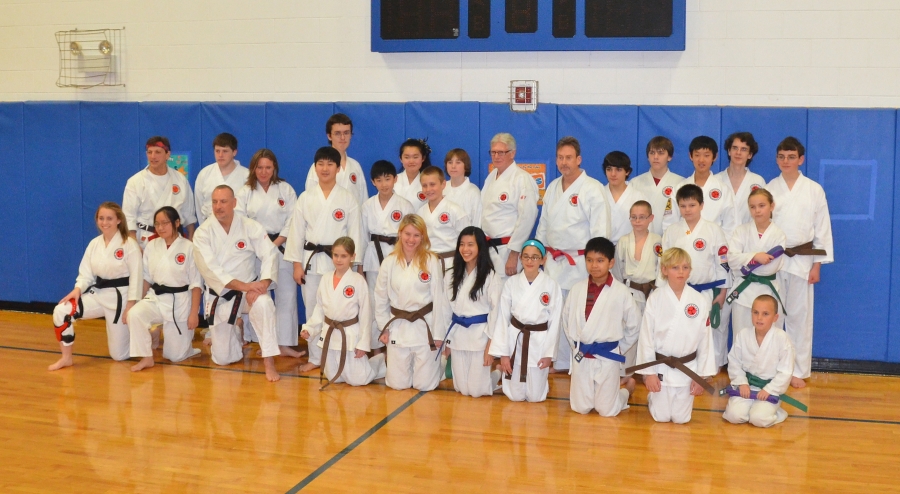
The True Martial Arts Academy held a black belt extravaganza promotional on Dec. 7th from 1-3 pm at the Plympton Elementary School in Waltham, Ma. With over 60 parents, grand parents and friends and 25 students in attendance for various ranks from Green belt to Black belt.

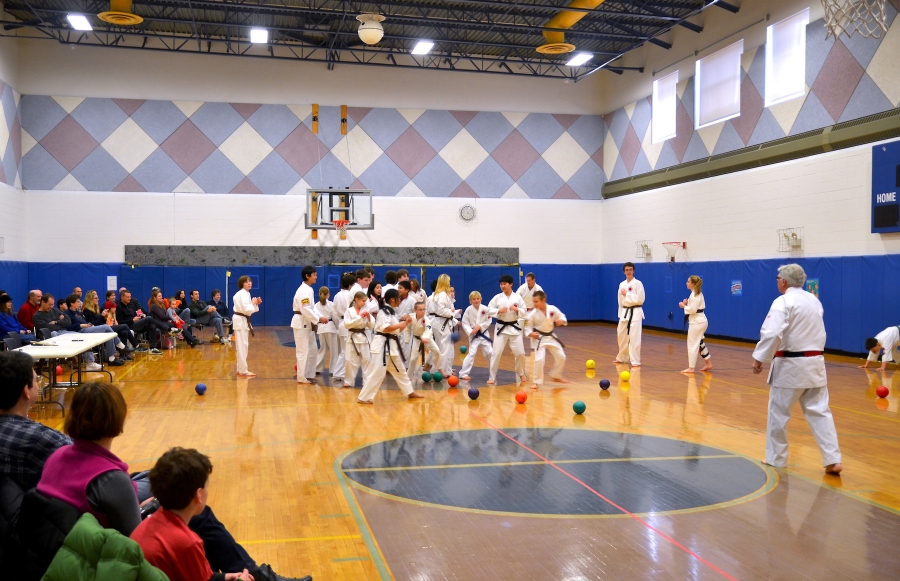



The testing started with warm ups, running, crawling, break falling and calisthenics around the gym, followed by dividing into different rank groups with a black belt advisor instructing them through the basics. This lead to drills, kata with bunkai and then self-defense against empty hand and then with knife, gun and club.
The final elements of the test were various methods of kumite against different sized students, large to small, multiple attackers and then against the adult Black Belts. We finished up with board breaking for all the black belt and Jr. Black Belt candidates and as expected it was a smashing success!
Congratulations to all the students who were promoted: (See Awards and Promotions Page)
Top of Page
Dojo's Got Talent Night
Waltham, MA
March 8th the True Martial Arts Academy hosted its first Dojo's Got Talent event!
The evening featured over twenty students aged 8 to 14 showing off their collective talents from comedic to musical instruments to dance to singing to amazing stuntman fighting. The laughs and applause where followed by pizza and then an excellent Jackie Chan and Jet Li movie "The Forbidden Kingdom".
Thanks to all the teens that helped make the evening a huge success, I look forward to the next one!
Top of Page
It is with great sadness that we recognize the passing of an old colleague, Craig N. Campbell, of Columbus, Ohio

For decades, Craig was a practitioner and teacher of Isshin-ryu karate. He was also a senior student in Kohgen Itto-ryu kendo and iaido under Kotaka Sadao Sensei. He eventually reached the rank of 6th dan in kendo and later replaced Kotaka Sensei as head of the Ohio State University's Kohbukan Kendo Club. He had also been the Scout Master of Troop #28 since 2005. A graduate of The Ohio State University, Craig, age 61, passed away on Sunday, February 9, 2014 in Columbus. He is survived by his mother, Eleanor Campbell; Janet, his wife of 30 years; children, Meghan (Johnathan) Hagelstein, Ian (Kristen) Campbell and Caitlin (Garrett) Kelly; grandchildren, Alice and Matthew, Morgan and Liam; brother, Scott Campbell; and sister, Krista (Kent Nielsen) Campbell. The family requests that in lieu of flowers, donations can be Troop 28 at North Broadway United Methodist Church, 48 E. N. Broadway, 43214. A friendly soul with a lively mind and a love for the martial arts, Craig has left us too soon. He will be missed by his family and many friends.
-- Papa Chris
Top of Page
Earning Eagle
by Jack Plank
I'm Jack Plank. I'm a 16 year-old junior at West Geauga High School, and I've been a member of troop 193 for six years, though Scouting has been a part of my life for much longer. It was in the first grade that I joined as a cub scout with about two dozen of my classmates. Back then it was nothing special. I wasn't too interested in learning about the outdoors; it was really just another place to spend time with my friends once a week after school. And yet here I am, ten years later, almost ready to earn the highest rank in Boy Scouting.

To become an Eagle Scout, in addition to all the required service hours, merit badges, and scouting experience, one must plan and carry out to completion their "Eagle Scout Project", a major service project to the benefit of his community.
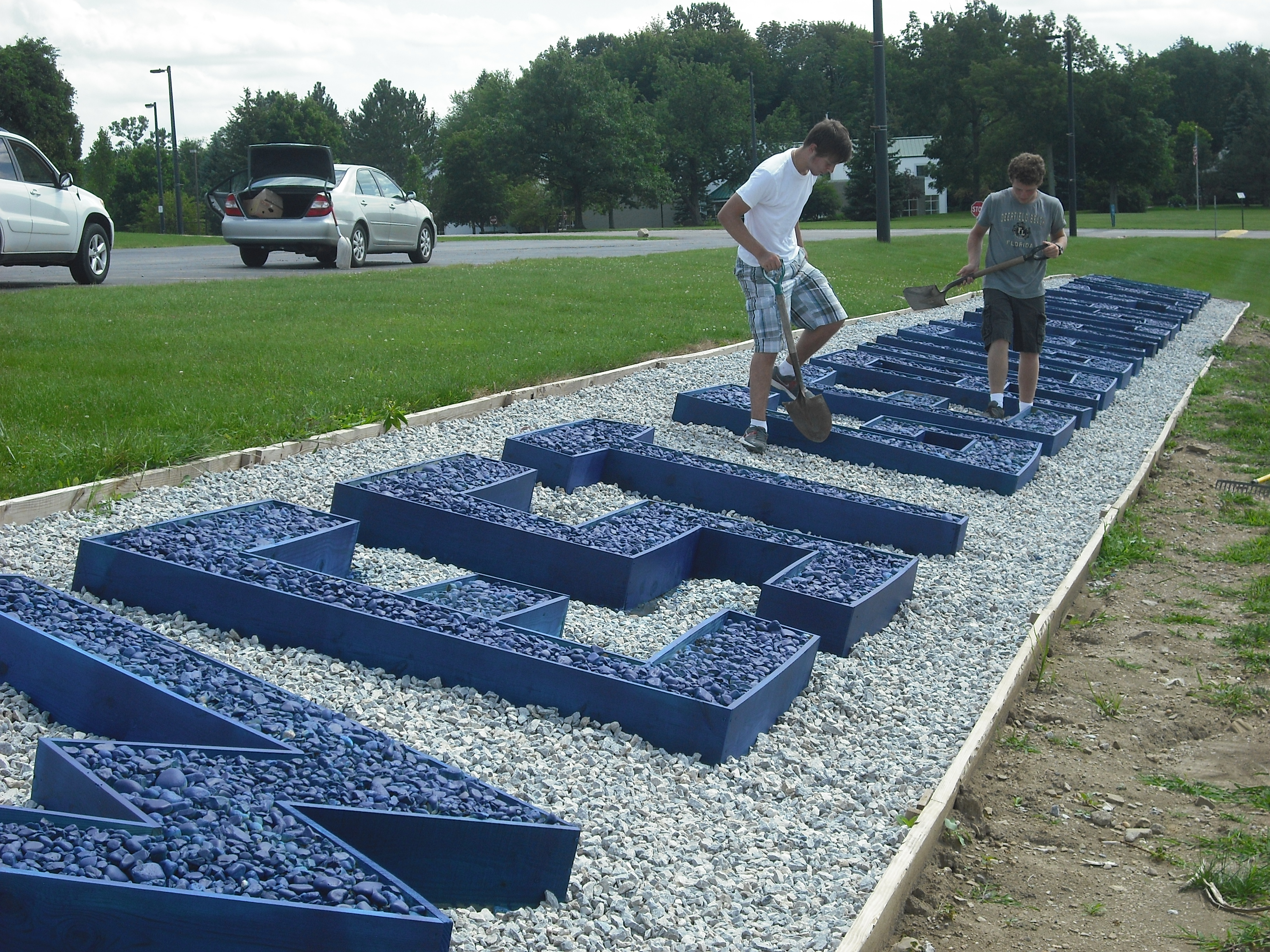
Over the summer I undertook the task of installing a huge sign in front of my high school to fulfill this requirement. It measures 130' by 10', with 6' by 4' letters spelling out "West Geauga High School". As seen in the picture, wooden frames filled with gravel painted blue make up the letters while the rest of the sign is filled with a thin layer of white limestone. The project used a total of about twenty yards of gravel and hundreds of wooden boards. Countless tons of dirt were also moved in the process of landscaping. The project took several hundred combined man hours from me, my friends, and members of my scout troop over the summer. I am just about done now, with the only remaining step being the planting of a few trees near the sign.
It's been a lot of work, getting where I am now in scouting. Not just with this project, but over the last few years. Only about 2-3% of boys who join scouting attain the rank of Eagle. Most drop out when they are given actual responsibility, when they realize that there is work to do and it's not all fun and games. I'm glad I didn't. I've learned a lot through scouting, not only about camping and nature but about preparedness, diligence, determination, problem solving, leadership, and more.
Karate and Boy Scouts have always been the two major extracurricular devotions of my life. After having recently hit a huge milestone in my training with my promotion to Shodan, it is just as satisfying to know that I am soon to hit an equally great milestone in scouting.
Top of Page
Ohio family competes in triathlon
by Becky Edwards
When Becky Edwards got her boys Zachary and Gabe into running she never expected this outcome! Ed.
My boys and I started a program in March to prepare us to run a 5k (3.1 miles) in June. A daunting task for an 8 and 10 year old, not to mention their mother! We would run intervals during the week (jog/walk) and meet with others in our group on Saturday mornings to run a little longer. One of the mentors in our group is an Ultra Marathoner (more than your typical 26 mile marathon) and told me that the boys had natural talent. They began running the full 3 miles that a 5k involves very early on in our training. By the time we came to our race in June, they were well equipped for the challenge.
Zachary (10) had already run a 5k trail run and came in 3rd in his age division. Talk about proud! Zach and Gabe both did very well in our scheduled June run, that had nearly 1000 runners in it. They asked if they could do it again, because they enjoyed it so much. So I looked online and found there were other events, not just the 5k events that we had been running in previously. I found a youth triathlon, that was in conjunction with the Greater Cleveland Triathlon/Duathlon that includes a Swim, bike and run.
I knew they would be fine at the biking and running, but was unsure of the swim. As it turned out, the swim was cancelled due to Lake Erie being too choppy the morning of the event. I was thrilled! They should have both been in the junior division, 7-10 year olds, but as it turns out, things are run differently in the triathlon community. Ages are determined by how old the participant will be at the end of the year. So Zach was moved up to the senior division, which was double the distance that we had been training for! Gabe's group was first, with a 1/2 mile run, 3 mile bike ride and 1/2 mile run to finish (technically a duathlon). He did very well, finishing in 22 minutes. Then it was Zach's turn. 1 mile run, 6 mile bike and finishing with another 1 mile run.
He was so nervous that he couldn't do it. But, amazingly, he did it in 41 minutes, 1st place in his age bracket. Both boys received finisher's medals and said it was one of the hardest things they've ever done.
And they want to do it again!
This mama couldn't be prouder!
Top of Page
A Tour of Gettysburg with Papa Chris

Pictured here: Papa Chris gives a tour of Gettysburg, PA during Summer Budo Camp
Top of Page
Karate Secret Video
Folks might want to check out this short introductory video advertising a longer set of DVDs for sale. It includes footage of the late, great Master Onaga Yoshimitsu of Shorin-ryu, Higa Yuchoku's top student; Shinjo Kiyohide, 9th dan Uechi-ryu and multi-year winner of the all-Okinawa tournament in kata and kumite; and Senaha Sensei, 9th dan Goju-ryu. See https://www.youtube.com/watch?v=E58PenmA-dY
Top of Page
Effective Bunkai Search
For those interested in creative, effective bunkai (applications) to their kata, search Youtube for the videos of Konstantin Drobyshevsky. Some very interesting ideas.
Top of Page
The Case for Kata/A Warrior's View of Fate, Iain Abernethy Video
In this month's podcast we cover two topics!The first thing we cover is "The Case for Kata" The question is often asked if kata itself plays a meaningful role in practise. If kata is nothing more than a repository for bunkai, then why not just practise the applications and do away with kata? Does keeping the solo forms, and devoting time to their practise, serve any meaningful purpose? Naturally, I think the solo form does have an important role to play; and in the first section I explain why. The second section of this podcast looks at "A Warrior's View of Fate"
http://iainabernethy.co.uk/content/warriors-view-fate-case-kata-podcast
Also New Online Videos: Karate Throws, An Arm-Lock Flow-Drill, Enpi / Wanshu Bunkai
Since last month's newsletter 30 minutes of new online bunkai videos have been added to the website and my "Practical Kata Bunkai" YouTube channel. The videos cover a number of karate throws, an arm-lock flow drill, and some bunkai from Wanshu / Enpi kata. To make them as easy as possible to find for newsletter subscribers, I have put all the videos on this webpage:
http://www.iainabernethy.co.uk/news/30-minutes-new-bunkai-videos
Top of Page
Joe Weider, titan of bodybuilding who mentored Arnold Schwarzenegger, dies at 93
The Washington Post, Published: March 24
 Joe Weider, titan of bodybuilding who mentored Arnold Schwarzenegger, dies at 93." Joe Weider was a legendary figure in bodybuilding who helped popularize the sport worldwide, one of the founders of the modern strength and fitness movement. For more on his career, see http://www.washingtonpost.com/local/obituaries/joe-weider-titan-of-bodybuilding-who-mentored-arnold-schwarzenegger-dies-at-93/2013/03/24/fed77bfe-9490-11e2-ae32-9ef60436f5c1_story.html
Top of Page
Jiujitsu Film Footage From 1912
From The Bartitsu Society
Here's a really cool website that contains footage from 1912 of Japanese martial arts and a demonstration of several formal jiujitsu techniques, look familiar, enjoy.
http://www.bartitsu.org/index.php/2013/03/jiujitsu-film-footage-from-1912/
Top of Page
Here's One for Us Old Folks
Hopkins becomes oldest boxer to win major title
By Denis Gorman, AP
The Associated Press
NEW YORK (AP) - Add another name to Bernard Hopkins' list of victims.
Hopkins became the oldest boxer to win a major title on Saturday night, scoring a 12-round unanimous decision over Tavoris Cloud to claim the IBF light heavyweight championship.
``It feels good. It feels real good,'' Hopkins said. ``I'm going to Junior's (Restaurant and) I'm going to have cheesecake.''
The 48-year-old Hopkins broke the record he set by beating Jean Pascal for the WBC light heavyweight title on May 21, 2011. When asked which fight meant more, Hopkins said ``tonight was better. Because I'm older. (It's) more gratifying.
``Tonight was one of the bigger fights (in my career).''
And while he reveled in what he accomplished, he was looking toward the future. Hopkins, who was adamant that he will not fight past 50, laid a challenge at the feet of the 175-pound and 168-pound divisions.
``I'm motivated to do it,'' Hopkins said. ``I don't believe anybody in the 175(-pound) weight class and possibly the 168(-pound) class can beat me.''
Hopkins, fighting his 19th title bout, improved to 53-6-2 in the main event of an eight-fight card at the Barclays Center. The 30-year-old Cloud fell to 19-1.
``It was great to break (in) the Barclays Center with a (legendary) performance,'' Hopkins said.
With Hopkins forcing a patient, technical match, Cloud was unable to press the issue and Hopkins circled him, landing jabs to his face, eventually opening a cut above his left eye.
``I have to throw a lot of substance (into fights). I'm fighting old school in a new world. (I) have to learn to adapt to what (the judges) are looking for,'' Hopkins said. ``We knew a 30-year-old guy was not going to run from a 48-year-old guy.''
Hopkins connected on 169 of 417 punches. Cloud landed 139 of 650.
``I was only average tonight,'' Cloud said. ``He hit me with an elbow but I'm not complaining. It is what it is.''
Top of Page
Two Cops vs. One MMA Fighter Training Drill
In this video you'll see several of the techniques taught in the GST Level 2 Instructor Certification Course demonstrated by Rener Gracie. Then, you'll see an Arrest Simulation Drill that was conducted on the last day of training. Two officers were randomly selected from the group and were told to arrest Brian "T-City" Ortega (Pro MMA Fighter) who would resist them with all his might. Although normally the officers would spend much more time verbally commanding the subject, since this drill was specifically designed to test their hands-on arrest and control procedures, they were instructed not to spend any time talking to the subject. Also, with knowledge of Brian's Fighting Prowess, these officers could have easily justify escalating his force, but once again, these officers were exclusively testing their hands-on arrest techniques on a trained MMA fighter. Notice how the officers were able to overcome Brian without having to escalate to strikes, batons, etc.
*Editors Note; The above paragraph is taken from the text on the You Tube video.
Enjoy the video below!
http://www.youtube.com/watch?v=HncwGDTNsxo
Top of Page
Keiko Fukuda, the first and only woman awarded the rank of 10th dan in judo, passed away
Keiko Fukuda, the first and only woman awarded the rank of 10th dan in judo, passed away February 11, 2013 in San Francisco. She was 99.
 The last surviving student of the founder of judo, Kano Jigoro, Fukuda broke from tradition as a young woman, choosing to train in judo under Kano rather than marry. Fukuda eventually followed Kano's wish that she and other students teach judo around the world. She came to the United States to do just that in 1966 and later settled here permanently. She became a leader in women's rights by example and voice.
Fukuda's promotion to judo�s highest rank came as a "total surprise," according to her caretaker, Shelley Fernandez. Then came a sense of great pride, "especially knowing that this promotion would help women's judo," Fukuda told Fernandez. "This is a dream come true," Fukuda said. She was awarded judo's highest rank by USA Judo, the national governing body for the Olympic sport in the United States in the summer of 2011.
Fukuda is the subject of a recent documentary, Mrs. Judo: Be Strong, Be Gentle, Be Beautiful. You can see her still teaching well into her 90s at https://www.youtube.com/watch?v=O2hWr0WPe7o or https://www.youtube.com/watch?v=U_HJkekcAvQ
Top of Page
Practical Kata Bunkai: Takedown and Strangle, Iain Abernethy Video
British sensei Iain Abernethy has come out with another nice (free!), quick bunkai application you may enjoy trying. Check it out at http://www.youtube.com/watch?v=SWmpsj82skw
Top of Page
Kickboxing Champion Joe Lewis Passes Away
 Famed martial artist Joe Lewis has passed away after a battle with cancer. He was 68 years old. Sensei Lewis served in the Marine Corps in 1962 and was one of the first marines to be stationed in Vietnam. While in Okinawa Joe began his training in Shorin-ryu karate under Grandmaster Shimabuku Eizo, earning his black belt. Upon his return home, Lewis trained and competed in the '60s and '70s in full contact Kickboxing and point tournaments, becoming United States heavy weight Kickboxing Champion among other titles. He competed in many tournaments against the likes of Chuck Norris, Frank Hargrove and Skipper Mullins and is known as "the father or American Kickboxing." Mr. Lewis was voted "greatest fighter in karate history" and inducted into over a dozen different martial arts halls of fame. Joe went on to write several books on fighting and strategies as well as dabbling in films. He may be best known for his part in "Force Five," among other movies. Mr. Lewis developed his own fighting system-"Joe Lewis Fighting Systems"-teaching thousands, sharing his knowledge with others. A true pioneer of the early martial arts in America, he will be missed. Read more about karate pioneer Joe Lewis here: http://joelewisart.com/biography-2/
Top of Page
The 20 Precepts of Gichin Funakoshi, Iain Abernethy Podcast
We think you will enjoy the latest podcast by Iain Abernethy. "The 20 Precepts of Gichin Funakoshi"
The twenty precepts are interesting and wide ranging and they give me an opportunity to talk about martial ethics, pre-emption, the importance of the correct martial mindset, the impact of the martial arts on life outside the dojo, the need for regular training, principles over techniques, the importance of avoiding conflict, awareness vs. paranoia, the purpose of stances, the application of kata in actual conflict, the difference between practicing and doing, the importance of mindful training, and more!" You can find it at http://iainabernethy.co.uk/content/20-precepts-gichin-funakoshi-podcast
Top of Page
Kayla Harrison wins women's 78K Olympic judo medal
Associated Press

LONDON (AP) - Kayla Harrison gave the U.S. its first judo gold medal in Olympic history, taking the 78-kilogram title Thursday at the London Games.
Harrison defeated Britain's Gemma Gibbons in a final she dominated from the start, getting a stronger grip on Gibbons and managing to throw her twice.
Her medal is the U.S.' second in judo this week: Teammate Marti Malloy won a bronze in the women's 57-kilogram division.
Harrison, world No. 4 and a former world champion, was in top form, dispatching many of her opponents with a match-ending ippon move, one in less than a minute. Harrison said she was focused on the gold.
"This is my purpose," she said.
The bronze medals were won by Audrey Tcheumeo of France and Mayra Aguiar of Brazil.
Top of Page
Tips For Success (Tip #6)
The credit belongs to those who are actually in the arena, who strive valiantly, who know the great enthusiasm, the great devotions, and spend themselves in a worthy cause; who at the best, know the triumph of high achievement, and who ,at the worst, if they fail, fail while daring greatly, so that their place shall never be with those cold and timid souls who know neither victory nor defeat.
- Theodore Roosevelt
Top of Page
Lyoto Machida; UFC Star and Kata Expert?
Lyoto Machida is a famous mixed martial artist who competes in the UFC, however, he began his training in Shotokan karate where he holds a 3rd degree black belt. watch him perform Shotokan kata Shochin for the paparazzi.
http://www.youtube.com/watch?v=J4gqY3by8ps&feature=player_embedded
Top of Page
Test your martial arts knowledge with this quick quiz
Just for fun, take this quick Karate Quiz! 10 questions to test your martial arts knowledge, but be careful!
http://www.ikigaiway.com/2012/deluxe-karate-history-quiz-fun-time/
If that quiz got your knowledge cells happy, heres another place to choose from a variety of quick quizzes rated easy to difficult!
http://www.funtrivia.com/quizzes/sports/martial_arts/karate.html
Top of Page
Verbal De-escalation, Iain Abernethy Podcast
Some of you may be interested in Iain Abernethy's latest offerings. Listen to his Podcast on "Verbal De-escalation" at http://iainabernethy.co.uk/content/verbal-de-escalation-podcast. Also of interest is the Online lecture on the history of karate by Charles Goodin and Pat Nakata at http://iainabernethy.co.uk/content/cgoodin-and-pnakata-history-karate
Top of Page
Sachiko Yamauchi Sensei Prough
The President of the United States Naginata Federation (USNF), Sachiko Prough has passed away in New Jersey at the young age of 52. She leaves her husband, well known Iaido expert, Sensei John Prough. Yamauchi Sensei, as she was known, grew up in Shikoku, Japan where she reached Naginata Shodan by the age of 16. She competed in various All Japan College Naginata Tournaments while in school often placing in the top 10% or better. Eventually she placed first in every All Japan level tournaments through high school, college and as an adult. Yamauchi Sensei went on to teach, coach and referee many Naginata tournaments. She held many offices including, Director of Ehime Naginata Federation and Advisor to All Japan College Naginata Federation in Japan. In America she was the President of the United States Naginata Federation and founded the Greater New York Naginata Federation. Yamauchi Sensei was promoted to the rank of Kyoshi in 1996, the second highest rank in Naginata and was one of the youngest ever to hold this title.
*Beisho members Kristen Pepe, Marisa Cimino and Jeanne McDonald of Waltham, trained often with Yamauchi Sensei in their tenure as members of the USNF.
Top of Page
Bob Anderson Fencing Master and Coach to Hollywood Actors Dies at 89
By T. Rees Shapiro, The Washington Post, Published: January 2
Bob Anderson taught swordsmanship to everyone from Eroll Flynn (the "original" Robin Hood) and Sean Connery to Olympic champions and the man who wielded the light-saber as Darth Vader. Read more about this remarkable swordsman and teacher, who died in January at "Bob Anderson, fencing master and coach to Hollywood actors, dies at 89." or cut and paste the following into your browser:
http://www.washingtonpost.com/local/obituaries/bob-anderson-fencing-master-and-coach-to-hollywood-actors-dies-at-89/2012/01/02/gIQAmrmyWP_story.html
Discipline and Defiance / Practical Karate
Another interesting podcast by one of Britain's leading martial arts authorities, Iain Abernethy. Enjoy.
http://iainabernethy.co.uk/content/discipline-and-defiance-practical-karate-podcast
Top of Page
Chantal Tavitian, Shodan Student Returns From Basic Training
PV 2 Chantal Tavitian, United States Army MOS -25B (IT Specialist) who had recently been promoted to shodan in June of 2011 has returned from her basic training at Fort Jackson, South Carolina, followed by her AIT Training at fort Gordon, Georgia.
Pictured here with Shihan Jim at the True Martial Arts Academy, her appearance was a surprise for her younger brother Shant, who was promoted to Jr. Gold Belt.
Congratulations to both and thank you for you service to our country.
 PV2 TAVITIAN CHANTAL
UNITED STATES ARMY
MOS- 25B (IT SPECIALIST)
BASIC TRAINING AT FORT JACKSON, SOUTH CAROLINA
AIT TRAINING AT FORT GORDON, GEORGIA
Top of Page
Newton Teen Fights Off Brutal Attack During Aruba Vacation
http://boston.cbslocal.com/2011/07/27/newton-teen-describes-how-she-fought-off-brutal-attack-in-aruba
Tips For Success (Tip #5)
Champions arrive early and stay late. They know what they're there for. They don't have to be told five times to do something or be given a five-minute lecture on how to do it. You give them the challenge, and they get it done.
There are people who work at 50 percent of their ability and who are successful. Then there are the ones who give 110 percent of everything they've got and barely make it. Which ones would you want? I'd rather have the people who give it their all and walk off the field knowing that. In business as in athletics, a champion is the person who at the end says, " I gave it everything I had ; win or lose, you got the best I can give.
- James Williams
paralypian, table tennis
Top of Page
Realistic Bunkai to Common Shuri-te and Naha-te Derived Kata
"For those of you especially interested in realistic bunkai to common Shuri-te and Naha-te derived kata, be sure to keep up with Sensei Iain Abernethey's many posts, youtube videos, and podcasts. His latest can be found at http://iainabernethy.co.uk/news/all-practical-kata-bunkai-pad-drill-videos-july-8th. You can also sign up for his e-newsletter at www.iainabernethy.com, which will inform you of new postings as well as his many public appearances, including in the US. He's on Twitter (http://twitter.com/iainabernethyand Facebook (http://www.facebook.com/iainabernethy) too. Abernethy is one of the few--and among the very best--at interpreting traditional kata with bunkai that really work and make sense (if you can understand his North England accent). I heartily endorse what he's doing and recommend his work to you.
- Papa Chris
Article Link: Battle for the Soul of Kung Fu
Be sure to check out the terrific article,"Battle for the Soul of Kung Fu" in the March 2011 issue of National Geographic (http://ngm.nationalgeographic.com/2011/03/shaolin-kung-fu/gwin-text). It's about the original Shaolin Monastety and has a lot of wonderful pictures as well as an interesting story."
The December 4th Test at Shorin Ryu Waltham (From the Perspective of an Ikkyu)
by Daniel Strauss
It's Saturday, December 4, 2010. You're about to attempt to get a stripe, or possibly even a belt. There's a tension in you; you know you'll get the promotion, but you still aren't sure you are going to feel like you earned it. Then you think back to all the other times that you've tested and you've felt worth it afterwards. You feel more confident now. But still, you have that tiny bit of tension nagging at you. Nagging at you for the testing to begin.
We all entered the dojo, which was mirrored on two of the three walls. One of the other two walls supported the shomen, the other was covered in equipment, and the floor was padded and green. To start, we did warm-ups. But these weren't quite our average warm-ups. In place of the usual things we would do in class or during other testings, we had to do a set amount of a specified technique, like 50 jab-reverses at our own speed. Also unlike most testings, there was a theme. It was "one step at a time." What this meant was that you had to complete every move in some kind of sequence as if you would be done with the sequence after that move. Suppose that this move was a punch. What Sensei would say to everybody was, "You just have to make one good punch." Until we had finished that move, we did not have to worry about the move that would come next. My gi, which was totally white, had to snap every time I did my "one good ________."
Another part of the procedure was when our group had to line up in front of each of the other groups in turn. What they would do was to put us in different grabs, and we had to escape. We also had to bunkai Fukyu Kata Dai Ichi, which means we had to figure out what the moves were doing to an enemy. There were five of us: four arranged in a diamond and the remaining one in the middle. We also had a higher-ranked adult overseeing us. We took turns going into the middle, and when we were in the center we were performing the kata. The rest of the group, in the diamond formation, was attacking and reacting to our moves from their respective directions. The highest kata we had to perform was Rohai, which we did not have to bunkai.
But these are only the things the people about my age and rank did. Other groups had alternate tasks to perform. The groups included those testing for the rank of kobudo deshi (student of weaponry), junior black belts, and black stripes on a brown belt. My group was the last of those three. There were also adults who were not testing. They were there to lead the test and make sure things went smoothly.
At the end, Sensei asked everybody to say how long they'd been taking karate and what karate had done for them. We went our separate ways after that, and I can just about guarantee that every one of us was extremely satisfied.
Top of Page
Winter Seminar November 2010
by Keith Martinek
On November 6th and 7th the members of the True Martial Arts Academy in Waltham were honored by the arrival of Sensei Ed Kearney and Sensei Jayne Butram. They came to Massachusetts and, along with Sensei Jim, lead our annual winter seminar. The main topics were close-quarter fighting and knife fighting techniques.


During the fighting seminar we spent time reviewing some basic strikes, and then worked them into a variety of combinations. We focused on jabs and reverse punches using angles to get in close, and then added leg strikes. For those that worked with Sensei Ed before and felt the pain of the "tom toi" kick this was a real reminder of how devastating this kick can be. Prior to the seminar we were cautioned to bring our shin pads. Thankfully for many participants Sensei Jim had some extra pairs. Everyone paired off and began to work combinations of jab, reverse, knee strikes and the tom toi kick.
For many of the participants this was a continuation of their training from previous knife fighting seminars, for others it was our first exposure. The group spent time reviewing some basics: proper grip, attitude, posture, strategy and strikes. We paired off to practice the distance and timing for cutting and thrusts. Sensei Ed took us thru a variety of drills and combinations designed to build our coordination with the knife. In this process we learned both techniques for offense and defense with the knife. The drills became very dynamic where in one drill the attacker worked a second attack after the defender seemingly blocked the strike. Another drill had both partners working a rhythm drill, roll and pick. Here one participant would decide to break the rhythm and initiate the attack
After the seminar, Sensei Jim hosted a gathering at his home. It was a very pleasant evening spent talking with friends and sharing karate stories. We spent time watching many old videos from past Beisho seminars and camps. It was fun to see bits of our history (and some of our most senior ranks as shodans and nidans) that has led us to where our karate is today.
There was a lot of hard work this weekend and many great memories. Thank you to Sensei Jim, Jayne, Ed, and all the SKKAA members that made this Winter Seminar possible.
Top of Page
Tips For Success (Tip #4)
The will to win is important, but the will to prepare is vital.
- Coach Joe Paterno
Top of Page
Sessa Kai
Mary Ann Vacherweill
As the name implies, Sessa Kai dojo grew out of a dedication to constant hard work and improvement on the part of Sensei Michael Pepe. Although the small space that held it for many years is closing for now, the Sessa Kai spirit did not begin, nor does it end on Waverley Avenue in Watertown. Sensei Mike's unusual spirit of tireless labor in combination with freely shared intellectual curiosity and passion for the martial arts was crafted over many years. He built these character traits in many different rooms with or without mats and mirrors. No matter the place, this spirit will continue to grow in the many who have trained with him. They take it with them to other dojos, driveways, libraries, gyms, and basements. And Sensei Mike will, no doubt, continue to unselfishly share the wealth of his knowledge where ever he is teaching.
Arigato gozai masu, Sensei. - Mary Ann Vacherweill
Click here to view Sessa Kai tribute pictures
Top of Page
[Editor's note: Say it ain't so! For those of us who began the martial arts in the 1960s, Anton Geesink was a hero and a role model, living proof that a Westerner could beat the best Japanese at their own game. Now he's gone! And he was 76! For me (and many others) he will always be the robust youngster who took on the best Japanese, and world, champions and beat them all, the first "foreigner" to win a Gold Medal at the Olympics, and at the 1964 Tokyo Olympics at that. Hail and farewell, honored warrior!]
Anton Geesink, 76, dies; Dutchman won first Olympic gold medal in judo
Toby Sterling
Tuesday, August 31, 2010; B06
Anton Geesink, 76, a member of the International Olympic Committee who won the first Olympic gold medal in judo, died Aug. 28 after several weeks in a hospital in his home town of Utrecht, Netherlands. No cause of death was reported.
The International Olympic Committee praised Geesink as a "great athlete" who "dedicated his entire career to the promotion of sport and its values." Mr. Geesink had been a member of the IOC since 1987.
The 6-foot-6 Dutchman stunned Japan by becoming the first Westerner to win the world judo championship in 1961 in Paris, and then won his Olympic gold in 1964 in Tokyo. He won another world title in Rio de Janeiro in 1965, along with a record 21 European championships.

Anton Geesink winning the 1964 Heavyweight Gold Medal in Judo at the Tokyo Olympics.
"Everybody will remember the gigantic stature of this Dutch figure whose size was equivalent to his kindness," the International Judo Federation said in a statement. "Anton Geesink never stopped fighting for the development of sport throughout the world."
Mr. Geesink was the first European to become a ninth-dan judoka in 1987 and was awarded the 10th degree in 1997 by the International Judo Federation.
The blue uniform worn by one competitor in international matches so that judges, referees and spectators can tell the athletes apart more easily arose from a suggestion made by Mr. Geesink at an International Judo Federation meeting in 1986.
"Today, Judo is a universal activity, thanks to the 'way of education' that Jigoro Kano created at the end of the 19th century," the judo federation's statement said. "But for sure, it would not have been possible if, first of all, Anton Geesink had not been the great champion he was and secondly, he had not become such a fantastic ambassador during and after his sports career."
Survivors include Mr. Geesink's wife, Jans, and their three children.
-- Associated Press
Samurai Spirit on Youtube
"We'd like to thank Sue Theise of the Wyoming Karate Club for drawing our attention to a fascinating series of short programs on the "Samurai Spirit," originally run on NHK World Television.
The first episode can be found at http://www.youtube.com/watch?v=XasE9DbHC_Y&feature=related.
It should lead you to the other episodes. Enjoy!"
Top of Page
Tips For Success (Tip #3)
Life doesn't require that we be the best, only that we try our best.
- H.Jackson Brown
Top of Page
The Journal Jissen
We'd like to call your attention to a free on-line magazine aimed at those who are interested in what its authors term "pragmatic traditionalism." The journal, Jissen, focuses on applications of traditional karate techniques to modern self-defense situations, including bunkai of traditional kata. While most articles are by Shotokan or Wado-ryu practitioners, their ideas are highly stimulating and have great applicability for Shorin-ryu practitioners. The magazine is run and edited by Iain Abernethy, one of the foremost experts on the realistic interpretation and practice of traditional karate. While we do not endorse products and cannot vouch for everything in Jissen, we encourage you to take a look at this free-bee. It's a real bargain! You can find it at http://www.jissenmag.com.
Top of Page
Oregon Karate Camp
by Ashley Hull, 5th kyu, Wyoming Karate Club
The drive from Jackson, WY to Oregon camp, in Neskown, is long; but it was completely worth it. We arrived in the area a day early and slept in Master Jim Null's dojo in Beaverton, OR. Master Null has a 6th degree in Taekwondo and is a good friend of Sensei Sue Theise. The next day we got the chance to train with him a bit. He taught us new stretches and a new warm up, called Tabata, that we are now starting to use in our dojo.
Before camp started we were also able to go see Sensei Lance and Delinda Morgan's dojo; the dojo is basically in their back yard. While visiting we learned that you shouldn't touch other people's weapons before asking. At camp, Sensei Lance taught the kid's part of camp. Sensei Lance, from Oregon Family Karate, was the host and without him and his wife Delinda (who did all the cooking) we wouldn't have gotten the chance to go.
We got the chance to meet Sensei Gonzo Flores, a Godan in Okinawan Kenpo, who was the head sensei at camp. Sensei Gonzo taught everyone Kenjo Seiko Bo-Bo Kumite as well as the kata Seisan. Kenjo Seiko Bo-Bo Kumite is a partner kumite, using bo, with an attacking and defending side. We all got the chance to learn both sides. Sensei Gonzo told us about the history of the kumite. It is originally from China, from around 600 A.D., and was used for military training.
Sensei Gonzo has a wealth of knowledge and was kind enough to share it with us. At the end of the first day we all gathered around and he shared some of what he knows with us. He went through a whole lineage of karate and was explaining how directly his style could be traced back. When he taught us Seisan he also told us how he could trace it back to Southern China; he is able to tell this because of the style of the moves.
Sensei Lance's son, Cole, taught us Saifa. We learned the kata in a short amount of time so we don't have it quite as well as Kenjo Seiko Bo-Bo Kumite, which we had two days to learn, though the WKC boys, Tige, Edgar, and Sean, really enjoy the kata. The timing of the kata is interesting and we are still trying to figure it out.
There were a little over twenty people at camp total. There were three groups that attended; Sensei Gonzo's, Sensei Sue's, and Sensei Lance's. Sensei Gonzo had one student, who earned the spirit award. We met a lot of other people who love doing karate and made some good friends.
At camp we learned Kenjo Seiko Bo-Bo Kumite; and two kata, Saifa and Seisan. But those weren't the only things that we worked on. We also had "focus drills", such as when a dog ran through our group or we stepped on a twig. Class on the beach was a memorable experience. Oregon summer camp was definitely one to experience, and a great personal first karate camp experience.
Top of Page
Hanshi Frank Van Lenten dies at 74
Beisho is sad to announce the unexpected death of Goju-ryu Hanshi Frank Van Lenten (12/4/35-7/1/2010) in Old Lyme, Connecticut. Hanshi Van Lenten trained with most of the major masters in Okinawa during multiple tours there with the U.S. Marine Corps and was dubbed the "strongest fighter" he had ever seen by Isshin-ryu founder Shimbakuku Tatsuo. Van Lenten was the only American ever to win both the kata and kumite divisions in an Okinawa championship tournament and holds the record in Okinawa for breaking the most tiles with a single strike. He held master level rank in Shorin-ryu, Isshin-ryu, and Goju-ryu, and had extensive experience in Okinawan Kobudo. Master Van Lenten had over 50 years experience in martial arts and was a pioneer in introducing the martial arts to the US.

Frank Van Lenten, 1935-2010
Van Lenten founded and for many years led the Goshindo Karatedo Association, which still has a number of schools in the east and northeast United States, before returning to his Goju-ryu roots and becoming a senior student of the late Shinjo Masunobu. He headed, and was later advisor to, the Okinawan Goju-Ryu Karate-do GoshinKai and the Ryukyuan Kobudo International.
He retired from the Marine Corps with over 20 years of service in the 1980s, which included serving as a Hand-to-hand Combat and Bayonet Fighting Instructor and Drill Instructor. In 1984, he was the guest of honor of the Governor of Okinawa in recognition of his propagation of Okinawan karate. Over the years, he received many honors in the martial arts. He was featured on the cover of Official Karate magazine and in 1986, was inducted into their Legion of Honor, Karate's Hall of Fame. He retired from active teaching at his dojo in Florida and spent some 20 years with the Tower Labs company in Connecticut prior to his retirement this past April.

Hanshi Van Lenten practing Goju-ryu techniques with a partner
Surviving him is his wife of 52 years, Felicidad (Faye) Van Lenten of Niceville, Florida, his half-sister, Caresse Morse of NJ, and two half-brothers, Tab Morse, of NJ and Roger Morse of CA. A Memorial service is scheduled for Sunday, July 25th at 3:00pm at the Centerbrook Meeting House, 51 Main St., Centerbrook, CT. Burial and ceremony will be at Arlington National Cemetery on August 18th.

Frank Van Lenten practicing Chinto kata in Isshin-ryu founder Shimabuku Tatsuo's courtyard in the 1960s
On a personal note, Papa Chris had the opportunity several times in the 1970s to train with Master Van Lenten. He was an imposing and powerful figure who combined enormous strength with considerable grace and a willingness to teach and encourage others to become better martial artists. While never seeking the fame or fortune of some of American karate's other pioneers, Van Lenten remained true to his principles and to the Okinawan way of hard training and striving for perfection and made major contributions to the introduction and improvement of the Okinawan martial arts in the United States.
Top of Page
Tips For Success (Tip #2)
Let your performance do the talking.
- H.Jackson Brown
Top of Page
Tips For Success (Tip #1)
One of my favorite sayings I got off a soda bottle: NO DEPOSIT, NO RETURN. To me that means you'll get out of life about what you're willing to put in. All champions have made great sacrifices to win their victories. So when someone talks to me about their goals and dreams, I ask them one question: " What are you willing to do about it?."
- John Naber
Four-time Olympic Gold Medalist, swimming
Top of Page
IGROW Talk and Interactive Board Breaking Event
March 4th Shihan Jim had the opportunity to speak at an event for Adolescent Wellness, Inc
Adolescent Wellness, a non-profit 501c3 organization, was founded to help deal with the growing problem of preventing depression and suicide among young people. A primary activity is creating awareness of prevention resources available to youth. Another activity is piloting programs for duplication by other communities. Participants are parents, peer leaders, clergy and educators.
The kick off event was dubbed the "Winter Blues," held at the Wellesley College Club in Wellesley Ma. The evening featured a blues and jazz band, an introduction of the leaders involved and an explanation of the IGROW program, (Interfaith Teens Gathering Round Our Wellness), facilitated by Dr. Nadja Reilly a psychologist from Childrens Hospital Boston. The IGROW program promotes wellness for teens through a series of four meetings, each called a TEAGOT (teens enjoying a good ol' time). Topics such as creative problem solving, developing coping skills, and stress relief are discussed, and interactive work is done with the teens by health care professionals and experts to achieve the desired outcome.
Talks were given by a yoga instructor and Shihan Jim on how mindfulness and relaxation can reduce stress. As an example to highlight the upcoming TEAGOT event on March 7th, Shihan Jim had three volunteers break a board on which each of them had written a worry or stress-related fear in order to break through. All three broke their boards and the evening was a great success.
Over 70 teens met for the TEAGOT program on Sunday with a choice of martial arts training, walking the labyrinth, and yoga, for the first half hour, followed by mural painting, massage and a smoothie bar. Twenty-six teens participated in karate, with the focus point being able to break a board by the end of the session. Each teen was given a board and asked to write a worry or stress-related thought on their board in order to break through the issue that concerned them. Shihan Jim had three sets of 8-9 teens come up and break simultaneously, all with a resounding kiai! Each set was successful and made for a very powerful demonstration.
All the teens had a fantastic time as the evening ended with a brief mediation and poem by the pastor of the church.
The success of the IGROW program in Wellesley will be next modeled in Waltham.
For more information check out their web site at www.adolescentwellness.org
Top of Page
Joy of jiu-jitsu helps Adam Dunn happily stay at first base
Dan Steinberg
The Washington Post
Friday, February 5, 2010; D02
No one has ever accused Adam Dunn of being Willie Mays with his glove, but the Nats' slugger has repeatedly said how much he enjoys playing defense. And with first base his anointed position heading into 2010, a few Nats fans had their interest piqued when Manager Jim Riggleman said Dunn was learning jiujitsu this offseason to help improve his agility.
"Adam can play good defense at first base," Riggleman told MASN on Dec. 19, when breaking the jiujitsu news. "Dunn is the least of our concerns."
Dunn was in town last week for the Nats' winter caravan, offering me my first opportunity to ask him about the Brazilian martial art and how it would help his job performance at first base this spring.
(Before I explain, let me note that Dec. 19 was also the date of the last Washington Snowvechkin. That means every time this city is under snowy siege, Nats fans are treated to Dunn jiujitsu news. I'd just as soon forsake the Dunn martial arts updates in exchange for not having to watch 17 "Max & Ruby" episodes from a snowbound house once a month, but I guess that's not up to me.)
Anyhow, the Dunn jiujitsu tale is possibly overblown, inasmuch as he's studied the sport off and on since he was 14, at the prompting of a childhood friend. He tapered off over the past four years, but got back into it this winter since his longtime gym is now more convenient to his offseason home.
He said the flexibility offered by the sport could theoretically help him at first, but that's not his primary motivation. But he said he was surprised how much he enjoyed playing first base, with the ability to chat an added benefit. For example?
"Depends who it is," he said. "I've got my buddies, and we've got a lot of things to talk about. Other people, I have no idea what to talk about. For instance, say Brian McCann was over there, I would probably make some sort of fat joke, something like that. I would talk to David Wright about how he can't hit homers any more. It depends."
Dunn reiterated his desire to spend his entire career in the National League, saying he's fine with designated hitting during interleague play but he never wants to do it full time.
"No chance," he said. "It's pinch-hitting four times. Pinch-hitting's hard."
And he also reiterated his desire to sign an extension with the Nats, despite the team's poor showing during his first year in D.C.
"Everything's looking up," he said. "They're doing everything they can. Before where I was, I didn't feel like they did everything they could to get better every year. Just one offseason on this team, they've done a lot of things to straighten out a lot of our problems. . . . . It wasn't that we kept running out bad players. If guys weren't getting the job done, WHOOO, they were out of here. They're trying to get all the right pieces."
Dunn loves MMA -- "people just see all the blood and that's what they think, but it's so tactical," he said -- and he enjoys the jiujitsu sessions, which could happen anywhere from one time to four times a week during the offseason. But he said he has no desire to get into a ring himself, finding first base a superior destination.
"I don't like getting hit in the face," he noted. "I don't care how big you are, you get hit in the face, it hurts."
Top of Page
Bastardization Of The Martial Arts
Mike Pepe
Let us say for the sake of argument that martial arts were put on the map when Soken Matusmura systemized his
techniques in 1830.
This makes all "modern" martial arts approximately 175
years old. Still young by historic standards.
Still, the martial arts have developed as quickly as
technology did after the invention of the microchip.
Only problem is, the microchip made technology better
unlike the martial arts, which now I fear, is in a sad state.
In any martial arts, system there would have been a
founder or Soke living in the 1900's. I give you Itosu
Yatsasune, Kano Jigoro, Choki Motobu, Choshin Chibana,
Funakoshi, Ueshiba and Nagamine to name a few. The list
of Soke would be a dozen.
A quick look in BlackBelt magazine reveals many videos
and DVDs depicting masters in sweatpants, muscle shirts,
camouflage clothing, wrestling pants and more. Long gone
are "traditional" masters in a neat white gi displaying a nice
lunge punch.
Sport karate has taken traditional karate techniques and
turned them into a gymnastics routine that only students of
Olympic caliber can attempt. Traditional weapons have been
shaved and colored to make them pretty and faster all to the
oos and aaahhs of the audience. Screaming and yelling
are now accepted as the "old fashioned" kiai.
Americans with little patience have turned their original style
(the style they started in) into "American combat techniques"
and "reality systems" of "karate". These systems, forged
with little discipline, have broken away from the idea of
posture and stance. If it works then it must be good. Photos
of large men with scowling faces overpowering an opponent
grace the pages of every magazine cover. Sadly, they miss
the point that it is hard for smaller people to "overpower"
anyone. Reality systems manhandle muscle and overpower
opponents claiming these are "techniques" of said system.
Mixed martial arts (MMA) which started with Helio Gracie
as the founder have accelerated the decline of the
traditional martial artist. Whereas the Gracie system uses
proven techniques using a gi, the "modern" MMA are
anything but. Long gone, from 10 years ago, are the clean
white gi and now only tight wrestling pants are worn. Martial
artists assume their system has nothing to offer and jump on
the jitsu bandwagon. Traditional Jiu-jitsu students now
practice a few years of boxing, Muay Tai, and other systems
to add to what was once a traditional style. People are
happy to "add" to their style, the next best thing since the
last thing they added to their style. The striking artist now
rushes to learn ground techniques to even the score.
There is no pure Jiujitsu-pure boxing-pure Shotokan
anymore.
Martial artists now embarrassed to show their "traditional"
self defense technique, call upon jujitsu,
Chin-na, wrestling, boxing, Muay Tai or any other "reality"
system rather than their time proven techniques.
There are not many schools around using a bear paw or
chicken beak. Long gone are the traditional stances of
Shotokan to make way for the (lazy) American fighting
stance. The low Sheiko dachi of Goju has now become a
stand up side fighting stance. These "traditional" techniques
I fear will soon become extinct in the martial arts community
only to be replaced with mauling techniques like head
grabbing elbows and knees.
The move toward reality and away from traditional martial
arts I fear will be the death knell for karate, as we know it.
Tradition.
Zero Mostel sang about it on "Fiddler on the roof" how to
cope with change that you can't stop.
Sadly, people break from their original style because it is
lacking in certain areas. Sometimes students break because
their style is to stiff feeling the style is so structured it leaves
no room for growth.
Modern martial arts can only be called "karate" in the
loosest sense of the word. The new form of the old karate is
now called Mixed Martial Arts.
"Students" who lacked patience or were rough to the
likens of Chotku Motobu disliked bowing, standing at
attention and washing the floor. They quickly dismiss these
things as unneeded. Students lacking the discipline to
practice scoff at time-honored kata.
Granted, people join karate for modern reasons none of
which is to learn a "traditional" Japanese art.
To think that by taking a Kempo style and adding some gun
defenses and calling it mike-ryu makes it legitimate seems
ok to these many entrepreneurs. There are literally
hundreds of these new systems on the market. Their only
claim to fame is they are reality based and the guy on the
cover is a Soke.
My feelings are that the more the X generation wants this
reality the less need there will be for Traditional schools
practicing an old art form. Enrolments will dwindle and
traditional dojo will dry up all becoming little club dojos with
only a few followers.
Consumers don't want the old stuff. They want the new. The
young and restless won't flock to a traditional dojo whereas
a more seasoned, mature adult might. The older consumer
understands what the younger seems to miss. I suppose
seeing someone being raked in the eyes in a photo will also
turn off a mature consumer!
A student, who bends his style, may somehow include
techniques that are not really his system, but where does
he/she start to break from the style hence having to rename
it.
I understand the round kick was shockingly new when it
came from China and I know Sensei Tom Wirtenan took the
spin kick to Ohio when he went off to college with
devastating results. However, did these things break from
the system?
These so-called masters all seem to have reinvented the
wheel. Get in, rake the eyes, knee, and do a wristlock or
something.
Man, it will be hard to decide where or when "traditional"
started. If we knew who "stole" from whom first it might make
things a lot easier.
A handful of styles consider themselves Koryu styles or
"ancient" styles. Author Dave Lowery to name one. There
are ancient styles of weapons, Iaido, karate and more.
These systems do not add to their system. They only teach
what the old master taught....Maybe in modern eyes they
don't have much to offer but maybe that is not their goal.
Beikoku Shorin Karate Do? Far from a Koryu style...I
remember a student wearing satin pants and a red, white,
and blue gi! He even introduced gymnastics kata in Kumite
kata nidan! LOL!
Where did traditional start? Could it be pre 1980? Before
1960? Was it 1500? I can do my karate using a traditional
jiujitsu move or a traditional small circle technique or a
traditional karate technique or a throw from the traditional
Kodokan series. Am I traditional?
The wheel takes a big turn. I was once a modern karateka
now the modern systems have passed me by (surpassed?)
Now I am considered traditional compared to the "now"
karate. Another time if I'm still around my style may become
fashionable again and I'll be the "now" karate.
Until then I'll keep my gi on thank you.
Top of Page
Excitement In France
Aaron Sewall
[Editor's note: Sensei Lance Morgan received the following email account from his black belt student, Aaron Sewall, who has been teaching English in France for the past two years;]
[Additional information provided by Sensei Morgan: Aaron is a 25 year old Nidan, about 5'7" and 145 lbs.]
Hi Sensei-
So, I have my first self defense story, and with a happy ending.
I was coming home from teaching Wednesday night, on the train. Before getting off in Chartres, two guys tried to rob me, or something. One started to say something to me, and then told me to give him some money. I told him I didn't have anything, so he slapped me. I jumped on him and popped him five or six times, then I backed off, which turned out to be a mistake. His friend got up and they both came after me.
I ended up slipping on the stairs of the double decker train, and they both jumped on top of me and tried to choke me while I was on the ground. I managed to push them off and get to the top of the stairs. I told them to stay where they were, but they followed me up. I got out the other side of the car, onto the platform. The one I had laid into didn't come off, but the other one followed me off and pulled a knife on me. Thankfully a cop with a dog was on the platform, and the guy ran off, the other one not far behind him. They were chased down and arrested.
When Steph picked me up at the train station, she was a little shocked because my clothes were covered in blood, though none of it was mine. Later at the police station, the police also congratulated me for being able to fight back, and doing something to them that they aren't allowed to do. I heard one of the cops say, "Those jerks didn't realize they had picked a fight with Chuck Norris."
It turns out, that the two had been robbing people for drug money. They stole an ipod from a 13 year old kid just after he got out of school. Then on monday, they robbed a girl at knifepoint and cut her hand. Apparently they thought I would be an easy target...
The trial was really quick. They were arrested on Wednesday night, and I spent all afternoon at the courthouse today. Quite an experience, considering that I've never been to a trial in the US, and to experience it in another country and another language is something else. During the trial they changed their story (they had confessed to the police when they were arrested) and tried to say that I had started a fight with them, insulting them, and then beating the larger of the two.
Needless to say, no one believed them, not even their own lawyers. The prosecutor said "I have a hard time believing that an expatriated English teacher coming home from work would decide to start a fight on the train with two unsavory characters such as these." They were both sentenced to 4 years in prison for attempted armed robbery.
So, thank you for the years of teaching, it helped me, the other people who were victims, and, if they hadn't been stopped, surely other people they would have hurt as well.
With love,
Aaron
Top of Page
Everything's Going to Be Just Fine
Xandra Reynolds
Karate is very grounding and centering for me. I used to go into 'karate withdrawal' any time I missed a class due to insurmountable college deadlines, and now I go into that withdrawal when a holiday interrupts the regular karate schedule. I need it. It is a joyful part of my life. I am attached!
There have been just a few times when I felt I didn't want to go--thinking I wouldn't be up to it for feeling overwhelmed with or just plain exhausted from the many things in my 'life outside of martial arts,' but the first time that happened, I told myself to have an open mind. I went anyway and I felt really great afterward! I told myself never to forget that feeling and I always remember that those rare times when I didn't feel like going were the times I especially needed to go! It quickly became apparent to me that I do not have a life outside of martial arts, for I have integrated it into so much I do in all aspects of my life.
On a physical level, I sensed that rolling around under my car to replace the exhaust system was not unlike a spell of Jujitsu, only my opponent was not a person, it was the car! I also felt I could not have lasted as long as I did unless my abs were toned from conditioning for class, although my neck muscles were quite sore from defying gravity for those few hours. Is there karate for the neck as well?!
Psychologically, karate has taught me how to want to fit in and fit well into other realms of my life. Once I finished college, I worried about not having some new slot to fill, be it grad school or a firm, etc. I was very thankful that karate class was a well-established normalcy to which I could keep belonging even though all of my other routines were fast dissipating with no new ones cropping up in the foreseeable future. When thinking about karate, I find a calm realization that all I have to do is figure out what the next step in my life has to be and why, just as I stand on the floor listening to Sensei Richard, thinking about the next step he tells me to take in a kata and why I am taking it.
So, when everything becomes overwhelming, I leave my uncertainties out in the parking lot and once I come out of the dojo, calm with smiles blanket me. 'Everything is going to be just fine' I catch myself saying as I drive the car back into the unknown.
Top of Page
The Lights Are On, and Someone's Home
Phil Gauer
This is a short story that helped me realize my daughters are paying attention in class. I've been training with Sensei Richard and Jo McCulty for just over one and a half years. This past summer I had two of my daughters, Julia (15) and Samantha (13), join our club. It is great to be with them in class, but for the most part we train separately during class. (For the sake of not embarrassing them to death, I almost never pair-up with them during partner training). So, I'm not always sure that everything we cover in class is sinking in. This little story demonstrates that I need not worry.
Samantha was recently at a large public gathering at one of the parks in our neighborhood. She had gone over to the park with our other daughter, Lily (8), looking for some of her friends (my wife and I were across the street at my parents' home). Two boys, probably about Samantha's age (but she did not know them), came up to her and told her it was "National Hug Day," and could they have a hug? Samantha told them something like "I don't think so," and turned and walked away with Lily. No big deal, and I think Sam handled the situation perfectly.
Later, when Samantha was telling my wife this little story, my wife warned Samantha never to fall for such a lame come-on from a stranger. My wife explained that once someone is in close enough for a hug, they could easily take advantage and turn the hug into a "grope." She told Samantha to always be ready to "knee a boy in the crotch." (I didn't know my wife thinks along those lines, but I'm glad to learn that she does).
Julia was quietly listening in on this conversation between Samantha and my wife. Then Julia weighed-in and added that before "kneeing" someone in the crotch, it's actually better to first distract them with some type of hand-fake to the face or throat, and then "knee" them in crotch. (I know this may sound a little weird, but I felt very proud of my "little girl" at that moment). As a result of the excellent training we've been receiving in class, Julia has improved upon a tried-and-true self-defense technique handed down from mother to daughter probably for many generations.
Incidentally, I just attended a weekend-long seminar in Cleveland with Sensei Jim True. We practiced many various wrist locks and arm-bar techniques, and most of the techniques begin with some type of distraction to the face of your opponent. Julia and Samantha were not with me at the seminar, but it's nice to know that both of them are thinking along the same lines as what Sensei True was teaching. It is a great comfort for a father to know that his daughters know how to take care of themselves if the situation calls for it.
Top of Page
Gracie In Action
Sensei Mike Pepe
Royce Gracie held a clinic in Newton, Massachusetts this past weekend. Jim McDonald and I went to his class, He showed great takedowns and ground work to about two dozen of us.
Imagine, this is the guy on TV in 1993 fighting these huge guys - and this 6'2" guy beat them all without throwing a punch!
During the clinic, Royce beckons me into his guard and applies a choke variation till I tap (but can't stop smiling!) Imagine, I watched this guy on my TV 15 years ago and today I'm in his guard!! How'd I get here!
At the end of the clinic he points to me and others, one at a time, and says "Put on a blue belt." Man! how could that happen! I watched him on TV with 5 or 6 friends and somehow life went on till our training crossed in Newton, Massachusetts, the class was small enough, and maybe I or someone made the right mistake for him to show it better, and the class was small enough for him to be near me and motion me into his guard.
Man, what a ride it's been!!

Top of Page
Way to Go, Wyoming
Two students from the WKC traveled to Green River, WY on May 17 to compete at the annual Western Wyoming Karate Championship. Zoe Curran took first place in kata in the eight-year-old beginner division and Nancy Morales Perez took fourth in the eight-year-old intermediate contest. Overall, 250 competitors from six states and numerous karate styles vied for honors.
Top of Page
Sparring
Ana G. R. Shook
The last night in the old dojo facility, I became aware of how the smell of sweat on a wet karate gi encompassed the essence of a dojo.
I bow to my partner,
acknowledging their spirit and power
I can smell the sweat on their karate gi,
wet from a previous match
A new challenge has arrived.
I breathe deep to tame the rush emotion.
Adrenaline is necessary,
but control and direction
are essential for peace.
To discover the secret for survival,
I must relax with every breath.
The challenger has a new secret.
A noetic lesson from a skillful fighter
Not driven by cold pure logic but,
instinctual responses evolving from years
of accepting new challenges.
Can I learn the control and precision
by breathing in the smell of sweat.
A karate gi wet from a previous match.
Top of Page
Japanese Puppet Theater in Boston
Sensei Mike Pepe
Bunraku, Japan's internationally renowned puppet theater from Osaka, returned this fall to Boston for the first time in more than twenty years and some Sessa Kai students were lucky enough to find tickets. One of Japan's most celebrated traditional art forms, each puppet is 3/4-life size and is manipulated by three puppeteers, moving together in such seamless coordination that the puppets seem human in all their actions and emotions. The dialog of all puppets, in Japanese mind you, is narrated by one person and the emotion is heightened by music played on a Shamisen (a kind on Japanese guitar). Students were treated to two plays approximately one hour each. A wonderful time was had by all!
Top of Page
Welcoming New Members
Beisho continues to grow, recruiting its members younger and younger. On June 9, Sensei Jen and Andrew Mohler recruited Denali Grace Mohler. (That makes "Papa Chris" "Grandpapa Chris"!) Jen is also finishing a Masters degree from George Washington University as a Physician Assistant.
Sensei Brian Farrell and wife Teleia had another baby boy Monday, October 14. Brody MacMaster Farrell arrived three weeks early, at 20 inches long and 7lbs.
Top of Page
Grappling with Fear
The North American Grappling Association (NAGA) held a tournament in Rhode Island the weekend of June 23. Two students from Sessa-kai's Wednesday night grappling class worked up the courage to compete.
Jim McDonald competed in two divisions, fighting once in each and receiving a second place. Linda Selima also fought in two divisions, fighting four matches. In the gi division, she lost to an armbar while ahead on points 6 to 0. The loss dropped her to fourth place.
Congratulations to both for having the courage to venture out and compete! Sensei Mike Pepe
Top of Page
Sensei Mike takes on Judo
Sensei Michael Pepe recently won third place in a judo tournament in February. Not bad, since he had never competed in judo before and entered after only a few lessons.
Top of Page
Beisho's Naginata Ladies Rock!
Sensei Kristen Pepe placed third in Engi (prearranged two-person forms) at the 2007 New York Naginata Championships. She was partnered with someone she had never worked with before and beat out competitors whose main pursuit is naginata. Very impressive! At an October 2007 seminar, Jeanne McDonald, Marisa Cimino, and Kristen Pepe, all received promotions two-step promotions in naginatado! Jeanne and Marissa went to nikyu and Kristen to ikkyu.
Top of Page
Japan Training Squadron Visits Boston
Sensei Mike Pepe
In June, two Japanese "Self-defense Forces" vessels visited Boston. The ships Yamagiri and the Amagiri docked from June 23rd -26th. On board were recently graduated cadets practicing their seafaring skills and touring the world. The ships were opened to the public, and cadets with kendo experience joined with local kendo enthusiasts in Medford to present an exhibition and to train alongside their American kendo counterparts.
Some members of the Sessa Kai dojo in Watertown were lucky enough to watch the presentation.
Entrance to the demo was free and we were presented with a display of kendo which began with warm ups, basics, freestyle shiai and point shiai. It was truly wonderful to hear the resounding whack! of the shinai and the spirited shouts of men! kote! and do! (head, wrist, chest), as each target was struck. We wish the Japanese sailors good luck and calm waters in their future travels on the open seas.
Top of Page
Shihan Jim True Honored
Shihan Jim True was recently nominated and accepted to the Middlesex Human Services Agency, Inc. Board of Directors. The MHSA is a non-profit agency that provides services for the following: Bristol Lodge Men's and Women's shelters, Sandra's House, Mary's House, Olivia's Place Family Shelters, Bristol Lodge Soup Kitchen, Answer House, Sullivan House, Project Outreach and Prospect Terrace Children's Center.
Shihan Jim's responsibility will include being a direct link to the community providing balance and structure necessary to meet public demands, while carrying on the commitment to the services MHSA provides.
The second major area of responsibility is formulating, guiding and overseeing the development of regulatory policies that will affect the operation of the agency. This is a task that carries the burden and responsibility of safeguarding the rights, welfare and quality of life for people who need its services. Finally, as an ambassador to the community, Shihan Jim will be involved with fund raising and assisting the agency in special events and projects.
The MHSA programs are funded in part by federal, state and municipal monies, while the remainder of donations are from civic, church and synagogue, corporate and individual donors. Shihan Jim looks forward to his involvement in developing the MHSA to be the best possible for the people and community that require it's services.
Top of Page
Haiku Contest Winners
The SKKAA is proud to name the winners of our spring and summer Haiku contest:
Adult division-Dan Glass, True Martial Arts Academy
Ancient roots, new leaves
This tree has grown since last spring
Ancient words, new truths
Runner-up-Ana Shook, Seishin Dojo
In heat of passion
Lost is the path through thicket
Cool rain clear the road!
Junior division-Meghan Boyle (age 11), True Martial Arts Academy
Master's River
It knows the pathway
Flowing forward, never back
A deep, moonlit path.
Top of Page
National Martial Arts Day in Waltham
Sensei Jim True
The True Martial Arts Academy invited all community members, students, and parents to celebrate National Martial Arts Day on Saturday, October 15th, with an Open House full of events for students and community members. The day began with morning karate classes (including Preschool, Children, Teen & Family classes) open to the community after a week of Bring-A-Friend to karate.
At noon, separate Safety Awareness and Anti-Abduction Seminars for children ages 5-14 and for Teen and Adult Women were held. The inte ractive safety seminars raised awareness about dangerous situations, and focused on developing appropriate responses to danger, including setting verbal boundaries and learning some basic escape strategies, in a fun and safe setting. Officer Anne from The Waltham Police Department came to the Academy to provide Child Safety Kits with Photo ID's. After the safety seminars, students were invited to participate in karate games, such as Danger Ball, and the True Martial Arts Academy Demo Team gave an enthusiastic and fantastic performance. The day culminated with the "Kicks Against Katrina" Kick-A-Thon fundraiser to raise money for the American Red Cross for Hurricane Katrina survivors (see article below). In all, the day was a great success, and we thank everyone who participated and had fun that day!
Top of Page
On National Martial Arts Day the Spirit of the Warrior Prevailed
Fran Boyle
On October 15, 2005, the Waltham True Martial Arts Academy celebrated National Martial Arts Day with a Kick-a-Thon to raise money for the victims of Hurricane Katrina. The idea was to have participants kick as many times as possible for 15 minutes, while family and friends sponsored them with a pledge either per-kick or a flat rate. All money raised was donated to The Massachusetts Bay Red Cross Katrina Relief Fund. With over 16,000 kicks recorded and $1,941.50 raised, I'm sure most of us were glad we opted for the flat rate!
Although the event was a physical challenge especially for the younger members of the Shorin-Ryu family it also challenged the spirit. When Sensei Jim first announced the Kick-a-Thon we all thought it was a great idea, but later when I found out that the event was to coincide with National Martial Arts Day the significance of the fund raiser took on a greater meaning.
To me the idea of a warrior is one who holds certain beliefs and ethics, a code of honor like those of the medieval knights. We have tried to teach our daughter that her training consists of more than just a physical ability but also a spiritual responsibility. Without this duality of purpose the possibility to train highly skilled bullies would be very real. Which is why I am sure there is so much emphasis placed on the teaching of conflict avoidance and resolution techniques. The Kick-a-Thon provided a spiritual link to the warriors of old; it was an opportunity for these modern day knights to practice their own code of honor and to reach out to those in need and serve the greater good, a lesson that was not lost on any of those who participated in the "Kicks Against Katrina".
Top of Page
WKC Starting the New Year with Spirit
Sensei Sue Theise
Members of the Wyoming Karate Club embraced the challenge set forth for them at their first class of the New Year - to do 2006 techniques. Other than the youngest students, everyone worked their hardest to accomplish the goal and go beyond. The 52 students who were at these classes threw a combined 130,000+ techniques. A variety of kicks, hand techniques, elbow and knees were done. Adult students were given the added challenge of using weights, cinderblocks, and hitting pads or makiwara. Thousands of push-ups, crunches, and jumps were added in for fun, but didn't count towards the goal.
Many youth students chose to stay longer to reach their personal goals. Special kudos go out to the following purple belts: 8-year-old Sean Batenhorst for throwing 400 beautiful jump kicks. 10-year-old Luke Meagher and 9-year-old Joseph Kravetsky, who led the kids with 5306 techniques, followed by 7-year-old Peter Frank at 4224. Brooke Jarvie and Malayna Jacobson set the pace for the adults with an amazing 6406 techniques. Also special recognition to the Adult Advanced class who, after they accomplished their 2006 techniques, elected to top it off with Shihan Jayne's torture high-middle-low multiple front kick set, which added 3300 techniques in just over 30 minutes.
Top of Page
From the Dojo to the Gridiron
This fall, Cole and Wyatt Morgan took their dedication, hard work, and martial spirit from the training mat to the football field, helping their team reach the second round of the State playoffs for the first time since 1972! Running back/outside linebacker Cole (17, photo at right) was named to the first team the All-League as running back and second team for defense. Wyatt (18, catching a pass below) made second team as a receiver and honorable mention on defense. During the hard-fought and narrowly-won first playoff round, Wyatt made three catches, gaining 40 years. Cole, a graduating senior, carried the ball 15 times and racked up 105 yards, including a 24-yard touchdown, helping his team, Yamhill-Carlton High School, win 33-28.
In the second round game, YCHS started off strong, leading at the half by 15-6. Hard hitting by the opponents, however, took out one YCHS wide receiver with a concussion. The kicker was also taken out of the game after being hit in the leg. The combination of injuries to his teammates apparently rattled the YCHS quarterback, affecting his passing accuracy and causing him to fumble the snap twice. Both fumbles resulted in touchdowns by the opposition, leaving YCHS behind 26-15 as time ran out. Congratulations to Cole and Wyatt for a great season. Now, it's on to basketball...
Top of Page
Sayonara, Miyagi-san!
Before there were Teenage Mutant Ninja Turtles, before there were Power Rangers, there were Mr. Miyagi and Daniel-san. The Karate Kid (1984) was one of the first movies to attempt to convey authentic Okinawan culture and show the true spirit of the martial arts. Miyagi-san passed away on Thanksgiving Day, 2005 at the age of 73. His real life was almost as fascinating as that of his mysterious karate character.
Pat Morita was born in California in 1928 to a family of migrant fruit pickers, a period when discrimination against Asians was at a high point. Morita spent much of his childhood in the hospital with spinal tuberculosis, and was shipped off to an internment camp during World War II. After the war, Morita took a job working on computers for an aerospace company, but by age 30, he had decided to pursue his passion-working as a stand-up comedian, the self-styled "Hip Nip." Morita also spanned two generations of film roles for Asians-from the stereotyped Fu Manchu and pidgin English-speaking servant to the honored sensei. "Miyagi's" example influenced countless students to take up karate and look deeper at Asian culture. Morita's last role may be his best. In a yet-to-be-released movie-"Only the Brave"-Morita played a Buddhist priest imprisoned in Hawaii after Pearl Harbor. The film is about the famous and highly-decorated Japanese-American 442nd Regimental Combat Team, told from the viewpoint of a Japanese-American.
Top of Page
A Dog of a Year
Xinnian Kuaile! Gonghei Fachoi. Akemashite Omedetou Gozaimasu! Seh heh bok mani bat uh seyo! Chzc M?ng Nam M?I! No matter how you say it, throughout the Chinese cultural world people will soon be wishing each other a "Happy New Year" as the Year of the Dog formally begins on February 4, 2006. According to Chinese reckoning, this is the year 4703. Those born in the Year of the Dog-1910, 1922, 1934, 1946, 1958, 1970, 1982, 1994, 2006-are loyal and honest and make excellent listeners. They are responsible and inspire confidence in others, have a compassionate personality, and offer kind words, advice, and assistance to friends and family. Dog-year people can also sometimes be narrow-minded and stubborn. Many worry a lot, underestimate their own abilities, and become introverted. They can be pessimistic-and sometimes nosy. Dog-year people can have a tough time finding the right match, but are most compatible with people born in the years of the Horse (1918, 1930, 1942, 1954, 1966, 1978, 1990, 2002) and Tiger (1914, 1926, 1938, 1950, 1962, 1974, 1986, 1998).
Top of Page
Home